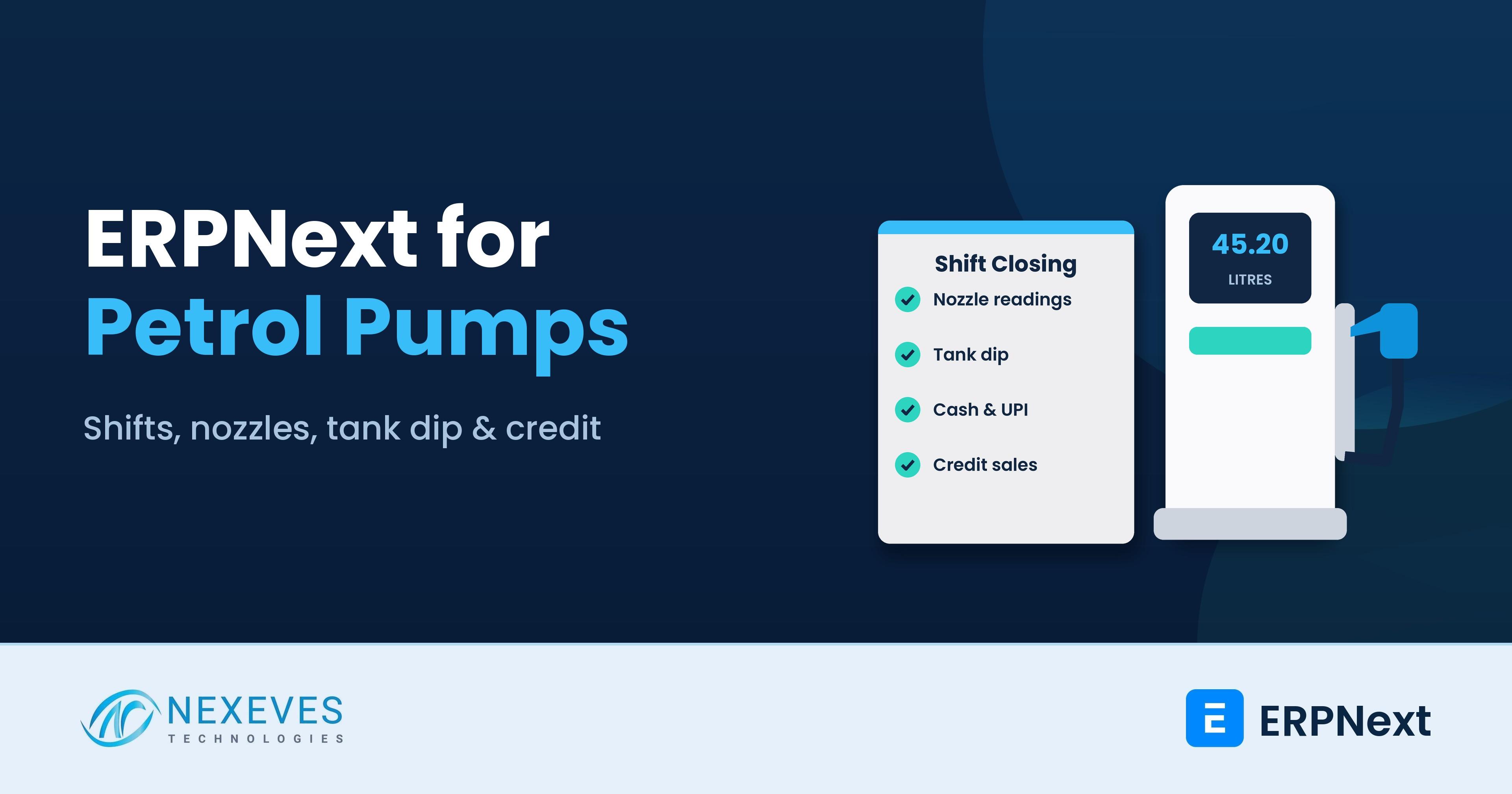
ERPNext for petrol pumps replaces the daily shift sheet, dip register and credit book with one system that ties nozzle readings, tank stock, cash and credit sales together. ERPNext has no ready-made fuel station module, but with a shift closing DocType, tanks set up as warehouses and a few reports, it handles the full daily cycle and your accounts in the same place.
Who this is for: petrol pump (petrol bunk) dealers of oil marketing companies, owners of multiple outlets, and transport companies with their own fuel stations in India, including Kerala.
Key takeaways
- Meter readings drive sales: opening and closing totaliser readings per nozzle give litres sold per shift.
- Tanks are warehouses: receipts, sales and dip readings keep tank stock and variance visible every day.
- Cash matches litres: shift closing compares expected value with cash, card, UPI, fleet card and credit sales.
- Tax handled correctly: petrol and diesel are outside GST and carry state VAT; lubricants and other items carry GST.
Running a petrol pump or fuel station?
Book a free 30-minute petrol pump ERP walkthrough. We will show a shift closing with nozzle readings, a tank dip reconciliation and a credit customer bill on ERPNext.
Show me shift closing → WhatsApp us: +91 8089051848
Or email info@nexeves.com
The daily headaches at a fuel station
- Shift shortages that are found days later, when nobody remembers what happened.
- Stock variance between book stock and dip readings, with no clear record of testing, evaporation or meter errors.
- Price changes that must be applied correctly from the right time.
- Credit customers such as transporters, institutions and fleet owners, with indent slips that pile up and statements prepared by hand.
- Separate books for fuel, lubricants and other income, making profit per outlet hard to see.
How a petrol pump is set up in ERPNext
| Pump element | ERPNext setup |
|---|---|
| Products | Items for petrol, diesel, premium fuels, lubricants and other goods, with fuel stocked in litres |
| Tanks | A warehouse for each underground tank, linked to its product and capacity |
| Dispensers and nozzles | A custom Nozzle master linked to its tank and product |
| Fuel prices | Item prices updated daily with effective date and time |
| Shifts | A custom Shift Closing DocType with nozzle readings, testing, cash and credit |
| Credit customers | Customers with credit limits, vehicle numbers and indent slips |
| Tank receipts | Purchase Receipt for each tanker load, with invoice and dip before and after |
Shift closing with nozzle readings
The shift closing record is the heart of the system. For each nozzle, the manager enters the opening and closing totaliser readings, and ERPNext calculates litres sold. Litres used for testing (for example the measure test) are entered separately and returned to the tank, so they are not counted as sales. The system then values the sales at the applicable price and compares the expected amount with what the attendant hands over:
| Expected | Collected through |
|---|---|
| Litres sold × price per product | Cash, card, UPI and wallet payments |
| Fleet cards and oil company loyalty cards | |
| Credit sales against indent slips | |
| Difference | Short or excess, recorded against the attendant |
When the shift is submitted, ERPNext posts the sales and the stock issue from each tank, records the payment modes in the right accounts, and logs any shortage. Managers see the shift result immediately, not at month end.
Daily price changes
Fuel prices in India can change daily. ERPNext item prices can be set with a valid-from date, and the shift closing can apply the correct price for the shift. If a price change happens mid-shift, the manager records readings at the change time so each part of the shift is valued at the right price.
Send us your daily shift sheet
Share one day's shift sheet and dip register. On a free call we will show how it maps to ERPNext and what can be automated.
Map my pump operations → WhatsApp us: +91 8089051848
Or email info@nexeves.com
Tank stock, dip readings and variance
Each tank's book stock comes from tanker receipts minus litres sold. Every day the manager records the dip reading, which a dip chart converts into litres for that tank. A custom dip register in ERPNext stores the reading and converted volume, and compares it with book stock:
- Small variances from temperature and evaporation are recorded within your allowed limits through stock reconciliation.
- Large variances are flagged for investigation of meter calibration, leaks or recording errors.
- Tanker receipts record dip before and after unloading, so short deliveries are visible straight away.
Density readings and other quality checks can also be recorded with each receipt and each day, giving you a complete register when inspectors or the oil company ask for it.
Credit customers and indent slips
Credit sales are a large part of many pumps' business. In ERPNext each credit customer has a credit limit and a list of authorised vehicles. Each fill is recorded with the indent or slip number, vehicle number, product and litres, either on the shift closing or as a separate entry. At the end of the billing period, ERPNext creates one invoice per customer with all fills listed, and sends the statement by email or WhatsApp. Accounts receivable ageing shows who is overdue, and new credit fills can be blocked when a customer crosses the limit.
Lubricants, shop and other income
Lubricants, coolants, accessories and convenience store items are sold through the ERPNext POS or on the shift closing, with barcode scanning and stock tracking. Other income, such as air and water services, rent from a shop or ATM, or commission income, can be recorded in the same books. Our post on ERP for retail shops in Kerala covers POS and shop stock in more detail.
Tax: VAT on fuel, GST on the rest
Petrol, diesel and some other petroleum products are currently outside GST, and state VAT or sales tax applies instead. Lubricants, accessories and most other goods and services are under GST. ERPNext handles both with separate tax templates per item, so fuel and GST items can even appear on the same customer statement with the right tax treatment. Set up GST with the India Compliance app as shown in our ERPNext GST setup guide, and confirm current state VAT rules and invoicing requirements for fuel with your accountant.
Staff, attendance and shortages
Attendants, managers and helpers are employees in ERPNext HR, with shift rosters and attendance. Shift shortages recorded against an attendant can be tracked over time and, if your policy allows, recovered through payroll. This is far fairer than ad-hoc deductions, because every amount links back to a specific shift closing.
Multiple outlets
Dealers with more than one pump can run each outlet as a branch or a separate company in ERPNext. Owners see consolidated sales, stock, credit and profit, while each manager sees only their outlet. Daily summaries can be emailed to the owner every evening.
Reports pump owners rely on
| Report | Why it matters |
|---|---|
| Daily sales by product and nozzle | Volume trends and dispenser performance |
| Shift result by attendant | Shortages and excesses over time |
| Tank stock and dip variance | Stock accuracy and loss control |
| Credit customer ageing | Overdue amounts and credit limit exposure |
| Lube and shop sales | Margin from non-fuel products |
| Outlet profit and loss | True profit after expenses, salaries and depreciation |
A practical rollout plan
- Masters: products, tanks, nozzles, dip charts, credit customers and opening stock.
- Shift closing: readings, testing, payments and shortages.
- Stock control: tanker receipts, dip register and variance reports.
- Credit billing: indent entry, periodic invoicing and statements.
- HR and reports: rosters, attendance, payroll and owner dashboards.
How Nexeves helps fuel station dealers
We study your shift sheet, dip register and credit book, then configure and customise ERPNext through our ERPNext implementation services. We load opening stock and credit balances, train managers and accounts staff in English or Malayalam, and support you after go-live.
Frequently asked questions
Does ERPNext have a petrol pump module?
Not as a standard module. ERPNext provides stock, sales, POS, HR and accounting, and a petrol pump setup adds nozzle masters, shift closing, dip registers and credit indent entry through customisation.
Can ERPNext calculate sales from nozzle meter readings?
Yes. The shift closing record takes opening and closing totaliser readings for each nozzle, subtracts testing, and calculates litres sold and their value at the applicable price.
How does ERPNext handle tank dip and stock variance?
Each tank is a warehouse. Daily dip readings are converted to litres with the tank’s dip chart and compared with book stock, and variances are recorded and flagged when they exceed your limits.
Can ERPNext manage credit customers at a petrol pump?
Yes. Credit customers have limits and authorised vehicles, each fill is recorded with its indent number, and ERPNext creates periodic invoices and statements with ageing reports.
Is GST applied to petrol and diesel in ERPNext?
Petrol and diesel are currently outside GST and carry state VAT, so they get their own tax template in ERPNext. Lubricants and other goods use GST templates. Confirm current rules with your accountant.
Can I manage multiple petrol pumps in one ERPNext?
Yes. Each outlet can be a branch or company, with managers limited to their own outlet and owners seeing consolidated reports.
Close every shift with numbers you trust
Nexeves implements and customises ERPNext for petrol pump dealers in Kerala and across India, with training for managers and accounts staff and support after go-live.
Book my free pump demo → WhatsApp us: +91 8089051848
Or email info@nexeves.com
Nexeves serves India & the GCC: UAE (Dubai, Abu Dhabi), Saudi Arabia (Riyadh, Jeddah), Qatar (Doha), Kuwait, Bahrain and Oman (Muscat).


No comments yet. Login to start a new discussion Start a new discussion