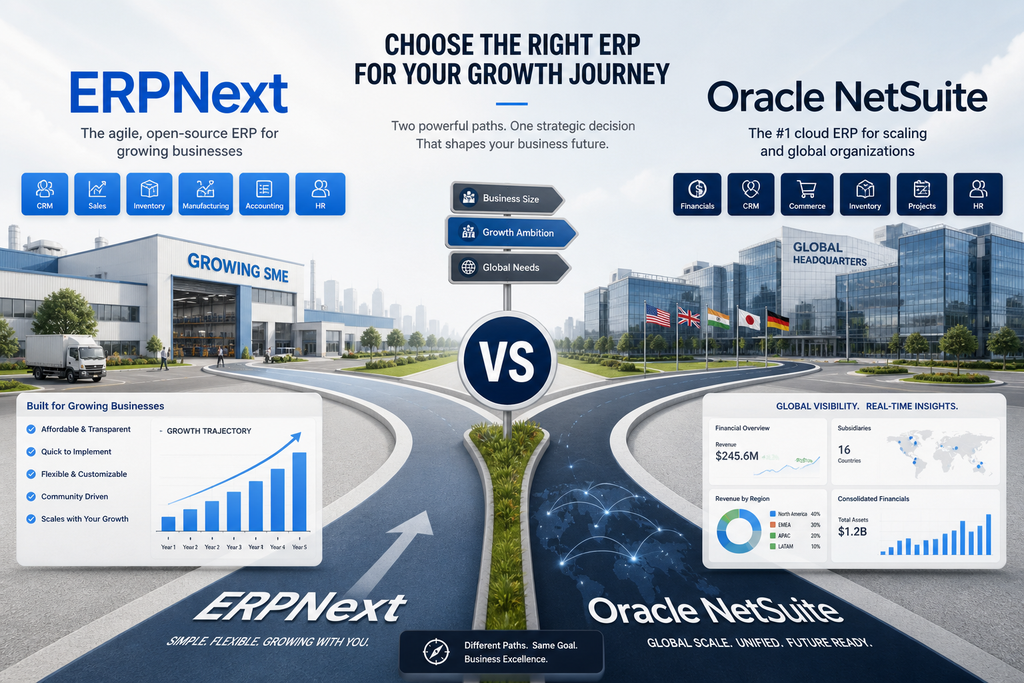
 ERPNext (open-source modular ERP) vs Oracle NetSuite (enterprise cloud ERP) — different strengths for different scales.
Introduction
Choosing an Enterprise Resource Planning (ERP) system is one of the most important technology decisions a business can make. The right ERP solution streamlines operations, improves productivity, enhances visibility, and supports long-term growth.
Two popular ERP platforms are ERPNext and Oracle NetSuite. While both provide comprehensive business management capabilities, they target different types of organizations and budgets.
This guide compares ERPNext and Oracle NetSuite across pricing, features, deployment, customization, scalability, integrations, manufacturing, accounting, and implementation to help you determine which solution best fits your business.
What is ERPNext?
ERPNext is an open-source ERP platform built on the Frappe Framework. It offers a fully integrated suite of business applications, including:
- Accounting
- CRM
- Sales
- Purchasing
- Inventory
- Manufacturing
- HR & Payroll
- Projects
- Asset Management
- Quality Management
- Helpdesk
- Website & E-commerce
ERPNext is ideal for startups, SMEs, manufacturers, wholesalers, retailers, healthcare organizations, educational institutions, and service businesses seeking a flexible, cost-effective ERP.
What is Oracle NetSuite?
Oracle NetSuite is a cloud-based ERP platform designed for growing and enterprise-level organizations. It combines ERP, CRM, financial management, inventory, e-commerce, and professional services automation into a single cloud platform.
NetSuite is widely used by multinational companies requiring advanced financial controls, global operations, and enterprise scalability.
Quick Comparison
| Feature | ERPNext | Oracle NetSuite |
|---|---|---|
| License | Open Source | Commercial Subscription |
| Deployment | Cloud & On-Premise | Cloud Only |
| Source Code Access | Yes | No |
| Customization | Excellent | Excellent |
| Implementation Cost | Lower | Higher |
| Ownership Cost | Lower | Higher |
| Manufacturing | Excellent | Excellent |
| Inventory | Excellent | Advanced |
| Accounting | Comprehensive | Enterprise Grade |
| CRM | Built-in | Advanced |
| API Integration | REST API | REST & SuiteTalk APIs |
| Mobile App | Yes | Yes |
Pricing Comparison
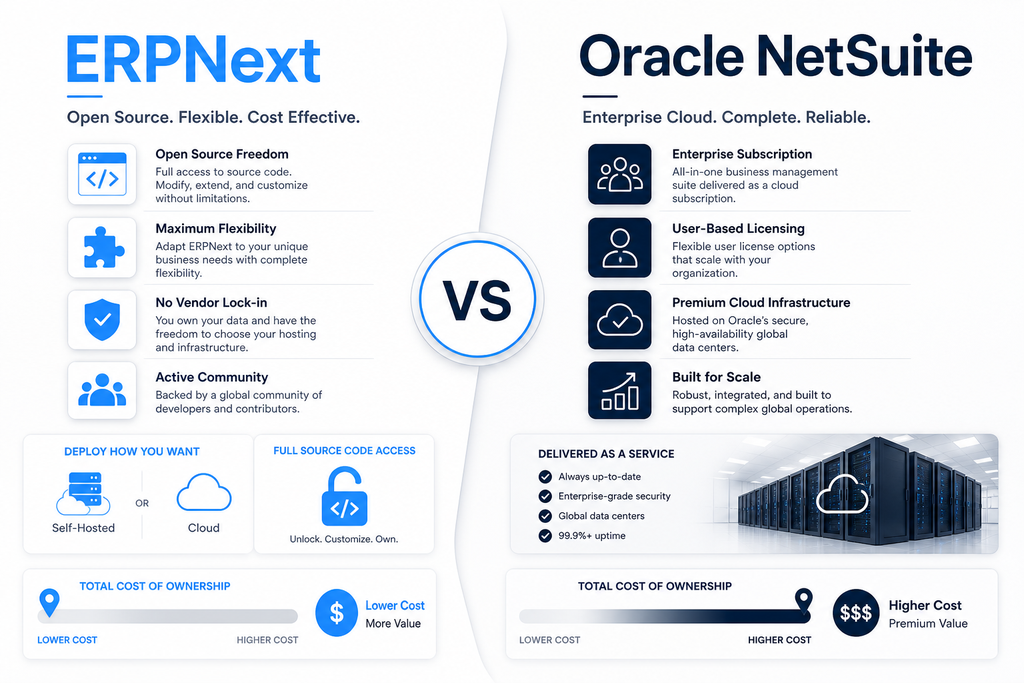 Pricing & ownership: ERPNext favors lower TCO and flexibility; NetSuite is built around enterprise subscriptions and scale.
ERPNext
Typical costs include:
- Implementation
- Customization
- Hosting
- User Training
- Annual Support
Since ERPNext is open source, businesses avoid traditional software licensing fees when self-hosted.
Oracle NetSuite
Typical costs include:
- Annual Subscription
- User Licenses
- Implementation
- Configuration
- Custom Development
- Support
- Additional Modules
NetSuite generally involves a higher total cost of ownership, particularly as user counts and business complexity increase.
Customization & Flexibility
ERPNext provides extensive customization through:
- Custom Fields
- Custom Forms
- Workflows
- Print Formats
- Reports
- Dashboards
- Client Scripts
- Server Scripts
- REST APIs
With source code access, businesses can tailor ERPNext to unique operational requirements.
Oracle NetSuite supports customization through SuiteScript, SuiteFlow, and SuiteBuilder, offering powerful capabilities within Oracle's ecosystem.
Financial Management
Both systems support:
- General Ledger
- Accounts Payable
- Accounts Receivable
- Fixed Assets
- Budgeting
- Cost Centers
- Tax Management
- Bank Reconciliation
- Financial Statements
- Multi-Currency Accounting
NetSuite offers advanced financial consolidation and global compliance features, while ERPNext provides comprehensive financial tools suited to most SMEs and mid-sized businesses.
Manufacturing & Inventory
ERPNext includes:
- Bill of Materials (BOM)
- Production Planning
- Work Orders
- Material Requirements Planning (MRP)
- Job Cards
- Quality Inspection
- Multi-Warehouse Management
Oracle NetSuite offers robust manufacturing, demand planning, warehouse management, and supply chain capabilities for larger enterprises.
CRM & Sales
ERPNext provides:
- Lead Management
- Opportunity Tracking
- Quotations
- Sales Orders
- Customer Portal
- Integrated Helpdesk
Oracle NetSuite includes advanced CRM with sales forecasting, marketing automation, customer service, and partner relationship management.
Reporting & Analytics
ERPNext offers:
- Real-Time Dashboards
- Custom Reports
- KPI Tracking
- Financial Reports
- Inventory Reports
Oracle NetSuite delivers advanced analytics, role-based dashboards, and enterprise reporting across global operations.
Integrations
ERPNext integrates with:
- Shopify
- WooCommerce
- Payment Gateways
- Mobile Apps
- Shipping Providers
- REST APIs
Oracle NetSuite integrates with:
- Oracle Cloud Services
- Salesforce
- Shopify
- Payment Platforms
- Banking Systems
- Third-Party Enterprise Applications
Advantages of ERPNext
- Open Source
- Lower Total Cost of Ownership
- Highly Customizable
- Source Code Access
- Cloud & On-Premise Deployment
- Built-in Website & E-commerce
- Rapid Implementation
- Active Global Community
Advantages of Oracle NetSuite
- Enterprise-Grade ERP
- Strong Global Financial Management
- Multi-Subsidiary Support
- Advanced Analytics
- Mature Cloud Infrastructure
- Comprehensive CRM
- Extensive Enterprise Integrations
Which Businesses Should Choose ERPNext?
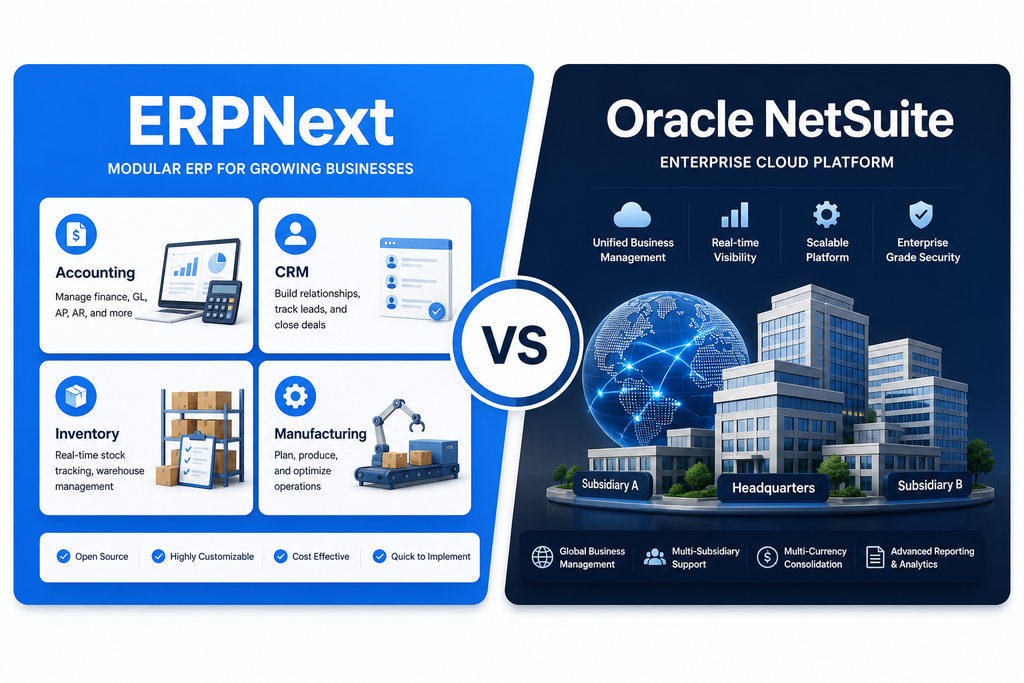 Decision guide: ERPNext for growing SMEs; Oracle NetSuite for complex global enterprises.
ERPNext is well suited for:
- Startups
- Small & Medium Businesses
- Manufacturers
- Trading Companies
- Retail Businesses
- Service Providers
- Educational Institutions
- Healthcare Organizations
- Businesses seeking flexibility and lower implementation costs
Which Businesses Should Choose Oracle NetSuite?
Oracle NetSuite is a strong choice for:
- Large Enterprises
- Multinational Organizations
- Businesses with Complex Global Operations
- Companies requiring advanced financial consolidation
- Organizations invested in Oracle technologies
Feature Comparison Summary
| Business Requirement | Recommended Solution |
|---|---|
| Lower Cost | ERPNext |
| Open Source | ERPNext |
| Source Code Access | ERPNext |
| Faster Deployment | ERPNext |
| Flexible Customization | ERPNext |
| Enterprise Financial Consolidation | Oracle NetSuite |
| Multi-Subsidiary Operations | Oracle NetSuite |
| Global Enterprise Management | Oracle NetSuite |
| SMEs | ERPNext |
| Large Global Enterprises | Oracle NetSuite |
Final Verdict
Both ERPNext and Oracle NetSuite are capable ERP platforms, but they serve different business needs.
If your business prioritizes cost-effectiveness, open-source flexibility, rapid implementation, and deep customization, ERPNext is an outstanding choice. It provides a comprehensive suite of business applications without traditional licensing costs, making it ideal for startups, SMEs, manufacturers, wholesalers, retailers, and service organizations.
Oracle NetSuite is a powerful cloud ERP designed for larger enterprises with complex financial structures, international operations, and advanced reporting requirements.
For many growing businesses, ERPNext offers an excellent balance of functionality, scalability, and affordability, making it a smart investment for long-term digital transformation.
Why Choose Nexeves Technologies?
At Nexeves Technologies, we specialize in ERPNext implementation, customization, integration, migration, user training, and ongoing support. Our team helps businesses streamline operations and maximize the value of ERPNext through solutions tailored to their industry and growth objectives.
Get in Touch
Planning ERPNext for your business in India or the GCC?
Book a free demo with Nexeves Technologies, an ERPNext implementation partner for India and the GCC.
Book a Free Demo Chat on WhatsApp
No comments yet. Login to start a new discussion Start a new discussion