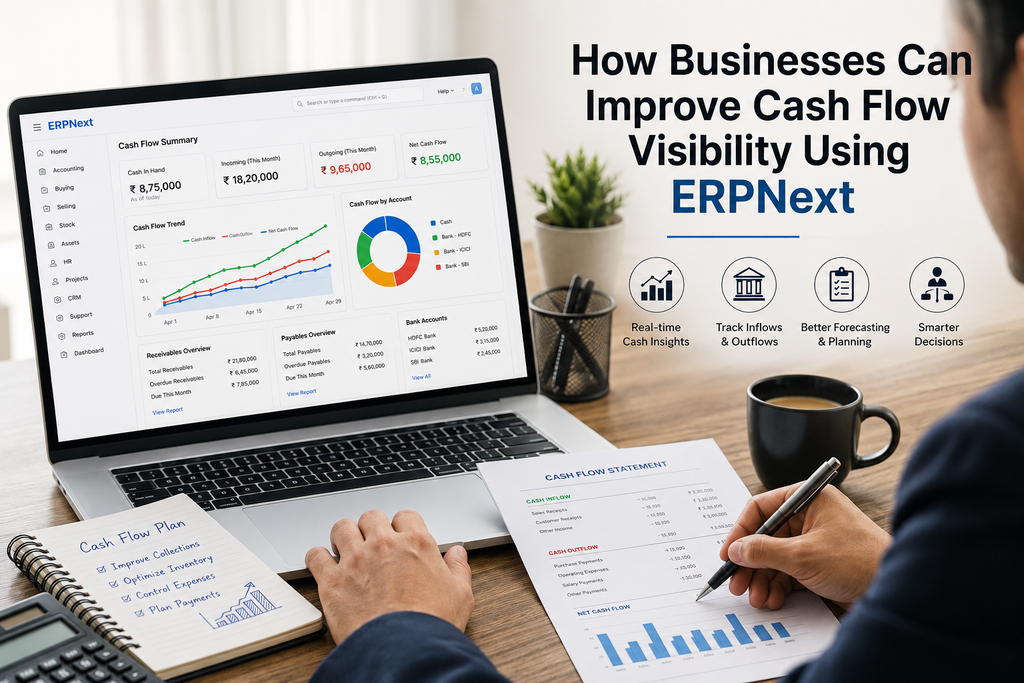
Cash flow is often described as the lifeblood of a business because it determines an organization's ability to meet daily operational expenses, invest in growth, pay employees, settle supplier invoices, and respond to unexpected financial challenges. While profitability is important, a profitable business can still face financial difficulties if it lacks sufficient cash at the right time. One of the biggest reasons businesses struggle with cash flow management is the lack of real-time visibility into their financial position. Many organizations continue to rely on spreadsheets, disconnected accounting systems, or manual reporting processes that make it difficult to understand where cash is coming from, where it is being spent, and what future cash requirements may look like. ERPNext addresses these challenges by providing a unified platform that connects accounting, sales, purchasing, inventory, payroll, and banking into a single integrated system. This enables businesses to monitor cash flow continuously and make informed financial decisions with confidence.
Cash flow visibility refers to the ability of a business to monitor and analyze all cash inflows and outflows in real time. It provides a clear picture of available cash, expected receivables, upcoming payments, and future financial commitments. Without proper visibility, businesses may experience delayed payments from customers, unexpected supplier obligations, excessive inventory investments, or inaccurate financial forecasting. These issues can lead to liquidity problems even when overall sales appear healthy.Traditional accounting systems often generate financial reports only at the end of a week or month, leaving decision-makers without timely information. ERPNext eliminates this gap by automatically updating financial records whenever transactions occur. Every sales invoice, purchase invoice, payment entry, journal entry, expense claim, payroll transaction, or inventory movement immediately reflects in the financial records, providing management with an accurate and up-to-date view of cash flow.
One of ERPNext's greatest strengths is its ability to centralize financial information from multiple departments into a single database. Instead of maintaining separate systems for accounting, inventory, purchasing, sales, and payroll, ERPNext integrates every business process into one platform.When the sales team generates an invoice, the finance department immediately sees the receivable. When procurement creates a purchase order, future financial commitments become visible. Inventory purchases, employee salaries, tax payments, operational expenses, and customer collections are all connected within the same ecosystem. This eliminates duplicate data entry, reduces errors, and provides finance teams with a complete financial picture without switching between multiple applications.Centralized information ensures that executives always have access to accurate financial data for better planning and strategic decision-making.
ERPNext provides interactive financial dashboards that display key financial metrics in real time. Instead of waiting for manually prepared reports, finance managers can instantly monitor the organization's cash position whenever they log into the system.The dashboard can display bank balances, outstanding customer payments, unpaid supplier invoices, monthly revenue, operating expenses, cash inflows, cash outflows, profit trends, and other important financial indicators. Decision-makers can quickly identify whether cash reserves are sufficient for upcoming obligations or whether corrective action is required.This real-time visibility helps businesses respond proactively rather than reacting after financial issues have already occurred.
Late customer payments are one of the primary causes of cash flow problems. Even businesses with strong sales may face liquidity issues if customers delay payments. ERPNext includes comprehensive Accounts Receivable management tools that help businesses track outstanding invoices efficiently.Every customer invoice includes payment terms, due dates, aging information, and payment status. Finance teams can easily identify overdue invoices through aging reports and customer statements. Automated payment reminders can be configured to notify customers before and after invoice due dates, reducing delays in collections.The system also provides detailed customer payment history, allowing businesses to identify customers with consistent late-payment behavior and implement appropriate credit policies. Faster collections directly improve cash flow and reduce the need for external financing.
Managing outgoing payments is just as important as collecting incoming cash. ERPNext allows organizations to monitor all supplier invoices, purchase orders, payment schedules, and vendor balances from a centralized interface.Finance teams can prioritize payments based on due dates, available cash, supplier agreements, and business priorities. Instead of making premature payments that reduce available working capital, businesses can schedule payments strategically while maintaining healthy supplier relationships.The system also prevents duplicate payments and provides complete visibility into outstanding liabilities, helping businesses plan cash requirements more accurately.
Bank reconciliation is essential for maintaining accurate financial records and understanding the actual cash available in business accounts. Manual bank reconciliation is often time-consuming and prone to human error.ERPNext simplifies this process by allowing businesses to import bank statements and match them against recorded transactions. Differences can be identified quickly, and unmatched transactions can be investigated immediately.Accurate reconciliation ensures that reported cash balances truly reflect available funds, allowing management to make better financial decisions based on reliable information.
Knowing the current cash position is valuable, but forecasting future cash flow is equally important. ERPNext enables businesses to forecast future cash availability by considering expected customer collections, scheduled supplier payments, recurring expenses, payroll obligations, tax liabilities, and planned purchases.Finance managers can anticipate periods of surplus or shortage and take corrective actions well in advance. For example, businesses can accelerate collections, postpone non-essential expenses, negotiate supplier payment terms, or arrange short-term financing before cash shortages occur.Accurate forecasting reduces financial uncertainty and improves long-term planning.
Inventory represents a significant investment for many businesses. Excess inventory ties up valuable cash that could otherwise be used for operations or business growth. ERPNext helps businesses optimize inventory levels through real-time stock monitoring, reorder level management, demand forecasting, and inventory valuation.By purchasing inventory based on actual demand rather than assumptions, businesses reduce unnecessary stock accumulation while ensuring sufficient product availability. Lower inventory carrying costs contribute directly to healthier cash flow.ERPNext also identifies slow-moving and non-moving inventory, enabling businesses to clear obsolete stock and recover locked-up capital.
Uncontrolled spending can quickly reduce available cash reserves. ERPNext includes budgeting features that allow organizations to define spending limits for departments, projects, and cost centers.As expenses are recorded, the system compares actual spending against approved budgets and alerts managers when budgets are nearing their limits or have been exceeded. This helps organizations control unnecessary expenditures and maintain financial discipline.With better expense management, businesses preserve working capital and improve overall cash flow stability.
Preparing financial reports manually often consumes significant time and may introduce errors. ERPNext automatically generates comprehensive financial reports such as:
- Cash Flow Statement
- Profit and Loss Statement
- Balance Sheet
- General Ledger
- Trial Balance
- Accounts Receivable Aging
- Accounts Payable Aging
- Bank Reconciliation Reports
- Budget Variance Reports
- Financial Ratio Analysis
Since reports are generated from live transactional data, management always works with accurate and up-to-date financial information. This supports faster decision-making and reduces dependence on manual spreadsheets.
Businesses operating across multiple regions often maintain several bank accounts and deal with multiple currencies. ERPNext supports multi-bank management and multi-currency accounting within a single platform.Finance teams can monitor balances across different bank accounts, track exchange rate fluctuations, and consolidate financial information without manual calculations. This capability provides complete visibility into global cash positions and simplifies international financial management.
Financial information is sensitive and should only be accessible to authorized personnel. ERPNext offers role-based access control, allowing businesses to define user permissions according to responsibilities.For example, accountants can record transactions, finance managers can approve payments, department heads can view budget reports, and executives can access organization-wide financial dashboards. This enhances data security while ensuring that employees have access only to the information they need.
Cash flow is influenced by nearly every department within an organization. ERPNext integrates finance with sales, purchasing, inventory, manufacturing, CRM, payroll, projects, and human resources.
For example:
- A confirmed sales order can be tracked until payment is received.
- Purchase orders become future payment obligations.
- Manufacturing costs are reflected in financial records.
- Payroll expenses are automatically posted to accounts.
- Project expenses update budgets in real time.
This seamless integration eliminates information silos and provides a complete understanding of how business operations impact cash flow.
ERPNext provides financial analytics that help businesses identify trends affecting cash flow. Management can analyze customer payment patterns, supplier payment history, monthly expense trends, seasonal revenue fluctuations, working capital utilization, and profitability by product, project, or business unit.These insights enable organizations to make data-driven decisions, optimize operational efficiency, improve collection strategies, reduce unnecessary spending, and strengthen long-term financial performance.
Businesses implementing ERPNext experience several advantages, including:
- Real-time visibility into cash inflows and outflows.
- Faster customer payment collections through automated receivable management.
- Better control over supplier payments and financial commitments.
- Accurate cash flow forecasting for improved planning.
- Simplified bank reconciliation and financial reporting.
- Reduced manual data entry and accounting errors.
- Better inventory management that frees up working capital.
- Enhanced budget monitoring and expense control.
- Improved collaboration between finance and operational departments.
- Stronger financial decision-making based on real-time analytics.
To get the most value from ERPNext, businesses should ensure that all financial transactions are recorded promptly and accurately. Regular bank reconciliations should be performed to maintain reliable cash balances. Automated payment reminders should be enabled to encourage timely customer payments, while supplier payment schedules should be reviewed to optimize working capital. Financial dashboards should be monitored regularly by management, and cash flow forecasts should be updated frequently to reflect changing business conditions. Integrating all relevant departments into ERPNext also ensures that financial data remains consistent and complete, giving decision-makers a holistic view of the organization's cash position.
Maintaining healthy cash flow is essential for the stability and growth of any business, regardless of its size or industry. Without clear visibility into financial movements, organizations risk delayed payments, cash shortages, poor budgeting, and missed growth opportunities. ERPNext provides a comprehensive solution by integrating finance with every major business function, delivering real-time insights into cash inflows, outflows, receivables, payables, inventory investments, and future financial obligations. With automated reporting, accurate forecasting, bank reconciliation, and centralized financial management, businesses can gain complete control over their cash flow. By adopting ERPNext, organizations move beyond reactive financial management and embrace a proactive, data-driven approach that improves liquidity, strengthens operational efficiency, and supports sustainable long-term growth.
📞 Want to explore how ERPNext can support your business growth?
Contact Nexeves today and take the next step toward a smarter ERP journey.


No comments yet. Login to start a new discussion Start a new discussion