In today's highly competitive and technology-driven business environment, organizations are increasingly relying on Enterprise Resource Planning (ERP) systems to streamline operations, improve productivity, and make data-driven decisions. An ERP system integrates various business functions including finance, sales, procurement, inventory, manufacturing, human resources, and customer relationship management into a single unified platform. By centralizing data and automating routine processes, ERP software helps businesses eliminate inefficiencies, reduce operational costs, and gain greater visibility across departments. However, before implementing an ERP system, one of the most important decisions businesses must make is whether to choose an Open Source ERP or a Proprietary ERP solution.
Although both types of ERP systems are designed to improve operational efficiency and support business growth, they differ significantly in terms of licensing, customization, ownership, flexibility, implementation costs, and long-term maintenance. Open source ERP systems provide organizations with access to the software's source code, enabling extensive customization and greater control over the platform. Proprietary ERP systems, on the other hand, are commercial solutions developed and maintained by software vendors, offering dedicated support, standardized functionality, and regular updates in exchange for licensing or subscription fees. Understanding the strengths and limitations of each approach is essential for selecting the ERP solution that best aligns with an organization's objectives, budget, and long-term strategy.
Understanding Open Source ERP
An Open Source ERP is a business management software whose source code is freely available for organizations to view, modify, and customize according to their unique operational requirements. Unlike commercial software that restricts access to its internal architecture, open source ERP platforms allow businesses to tailor workflows, develop custom modules, integrate third-party applications, and enhance functionality without being limited by vendor restrictions. This flexibility has made open source ERP increasingly popular among startups, small and medium-sized enterprises (SMEs), manufacturing companies, service providers, and organizations with highly specialized business processes.
One of the most significant advantages of open source ERP is the absence of expensive software licensing fees. Businesses can allocate their budgets toward implementation, customization, employee training, and infrastructure rather than recurring software subscriptions. This makes open source ERP an attractive option for organizations seeking a cost-effective digital transformation strategy. Additionally, since businesses own and control their ERP environment, they are free to choose implementation partners, migrate hosting providers, or continue development independently without being locked into a single software vendor. This level of ownership provides long-term flexibility and reduces dependency on external providers.
Another notable benefit is the transparency offered by open source software. Since the source code is publicly accessible, developers and security experts can continuously review, improve, and strengthen the platform. Organizations gain complete visibility into how the system operates, making it easier to perform security audits, maintain compliance, and implement organization-specific security measures. Furthermore, active developer communities continuously contribute enhancements, bug fixes, and new features, allowing open source ERP solutions to evolve rapidly in response to changing business needs.
Despite these advantages, implementing an open source ERP requires technical expertise and careful planning. Businesses must manage software updates, security patches, infrastructure, and custom developments either through internal IT teams or experienced implementation partners. Without proper project management and governance, extensive customizations may increase implementation complexity and maintenance efforts. Therefore, while open source ERP offers exceptional flexibility, organizations must ensure they possess the necessary technical capabilities to maximize its potential.
Understanding Proprietary ERP
A Proprietary ERP is a commercial software solution developed, owned, and maintained by a software vendor. Organizations purchase licenses or subscribe to cloud-based services to access the software, while the vendor remains responsible for product development, maintenance, security updates, and technical support. Unlike open source ERP, the source code is not accessible to customers, limiting their ability to customize core functionalities beyond the options provided by the vendor.One of the primary reasons organizations choose proprietary ERP systems is the availability of professional vendor support. Businesses benefit from dedicated implementation consultants, service-level agreements (SLAs), regular software updates, technical assistance, and comprehensive documentation. This structured support significantly reduces implementation risks and ensures that critical business operations remain stable. Additionally, proprietary ERP vendors often provide industry-specific templates, predefined workflows, and best practices that accelerate deployment and reduce the need for extensive customization.
Proprietary ERP systems also invest heavily in user experience, security, regulatory compliance, and cloud infrastructure. Vendors continuously enhance their platforms by introducing advanced technologies such as artificial intelligence, predictive analytics, machine learning, and automation tools. Many proprietary ERP solutions offer integrated modules for customer relationship management, supply chain management, business intelligence, payroll, and financial reporting, creating a comprehensive enterprise ecosystem.However, these advantages come with considerable costs. Organizations must pay recurring licensing fees, annual maintenance charges, subscription costs, and additional fees for premium modules or advanced features. Over time, these expenses can significantly increase the total cost of ownership. Moreover, businesses often become dependent on the vendor for software updates, feature enhancements, and technical support, creating vendor lock-in that may limit future flexibility. Customization options are also generally restricted to protect the integrity of the software, meaning organizations may need to adapt their business processes to fit the system rather than the other way around.
Comparing Open Source ERP and Proprietary ERP
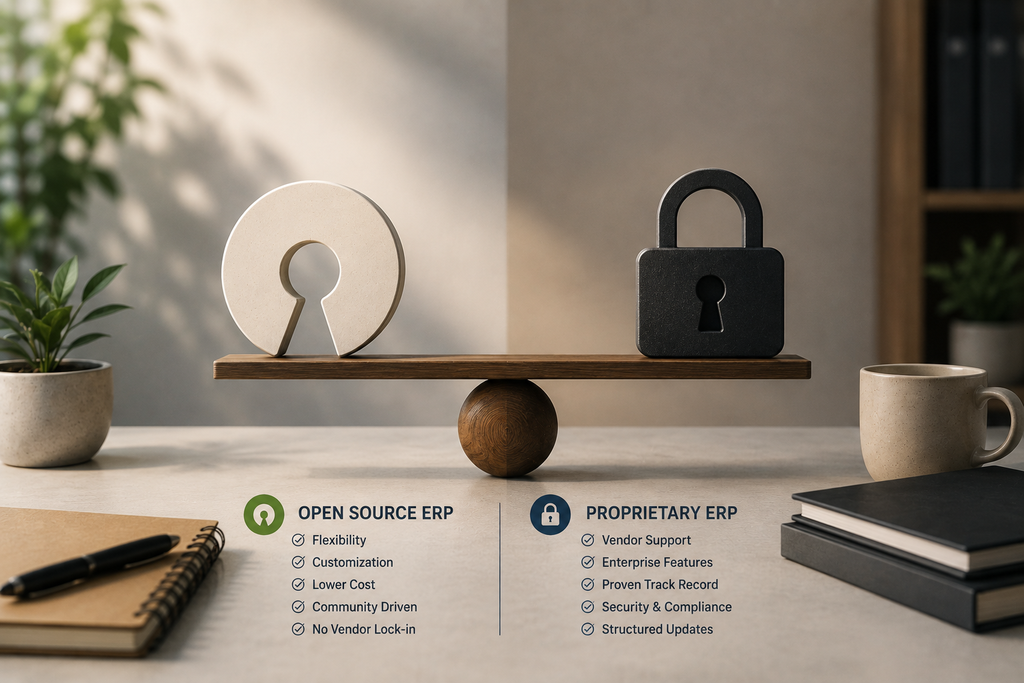
The differences between open source ERP and proprietary ERP extend beyond software licensing. They influence how organizations manage costs, innovation, customization, scalability, and long-term growth. Open source ERP provides unmatched flexibility by allowing businesses to modify every aspect of the system according to operational requirements. This is particularly valuable for organizations with unique workflows or industry-specific processes that cannot be accommodated by standard software configurations. Proprietary ERP, while offering limited customization, provides standardized processes that align with industry best practices, making implementation more predictable and easier to manage.
From a financial perspective, open source ERP generally requires a lower initial investment because businesses are not burdened by recurring software licensing fees. Although implementation and customization costs still exist, organizations often achieve lower long-term ownership costs compared to proprietary solutions. Proprietary ERP, on the other hand, requires continuous subscription or licensing payments, making it a larger financial commitment over time. However, these recurring costs often include vendor support, regular updates, infrastructure management, and security maintenance, reducing the internal workload for businesses.
Scalability is another important consideration. Both ERP models support organizational growth, but they achieve scalability differently. Open source ERP scales through custom development and infrastructure expansion, while proprietary ERP allows businesses to activate additional modules or purchase higher service tiers as their requirements evolve. The choice ultimately depends on whether an organization prefers complete flexibility or structured vendor-managed growth.
Business Impact of ERP Selection
Selecting the appropriate ERP solution has a direct impact on business performance, operational efficiency, and competitive advantage. Organizations implementing the right ERP system often experience improved collaboration between departments, faster decision-making, increased process automation, enhanced customer service, and greater visibility into financial and operational performance. By centralizing information and reducing manual work, ERP systems enable employees to focus on higher-value activities that contribute to business growth.Open source ERP can significantly improve innovation by enabling organizations to develop custom applications, automate specialized workflows, and integrate emerging technologies without waiting for vendor approval. This flexibility allows businesses to respond quickly to changing market conditions and evolving customer expectations. Proprietary ERP, meanwhile, delivers stability, reliability, and enterprise-grade support, making it particularly attractive for organizations operating in highly regulated industries or environments where system availability is mission-critical.
Security is often a major concern when evaluating ERP solutions. Contrary to common misconceptions, open source software is not inherently less secure than proprietary software. Security largely depends on implementation quality, infrastructure management, regular updates, and cybersecurity practices. Open source ERP benefits from continuous community review, while proprietary ERP relies on dedicated vendor security teams and controlled software updates. Both approaches can provide robust security when managed effectively.The long-term return on investment (ROI) also varies depending on business objectives. Organizations that require extensive customization and wish to minimize recurring software expenses often achieve greater ROI from open source ERP solutions. Conversely, businesses seeking rapid deployment, predictable support, and minimal technical involvement may realize better value from proprietary ERP despite the higher licensing costs.
Choosing the Right ERP for Your Business
There is no universal answer to whether open source ERP or proprietary ERP is the better choice. The decision should be based on a careful evaluation of organizational priorities, available resources, future expansion plans, and operational complexity. Startups, small businesses, and rapidly growing organizations often benefit from the flexibility, affordability, and customization capabilities of open source ERP. Larger enterprises with strict compliance requirements, standardized business processes, and limited internal technical resources may find proprietary ERP more suitable due to its comprehensive support and enterprise-level infrastructure.Before making an investment, organizations should assess the total cost of ownership, implementation timeline, customization requirements, scalability, integration capabilities, data security needs, vendor reliability, employee training requirements, and long-term business objectives. Selecting an ERP is not merely a software purchase but a strategic decision that influences every aspect of business operations for years to come.
The debate between Open Source ERP and Proprietary ERP ultimately comes down to balancing flexibility, cost, control, and support. Open source ERP empowers organizations with complete ownership, unlimited customization, lower licensing costs, and freedom from vendor lock-in, making it an ideal choice for businesses seeking adaptability and long-term cost efficiency. Proprietary ERP, meanwhile, offers structured implementation, dedicated vendor support, advanced enterprise features, and managed software maintenance, making it well suited for organizations that prioritize stability, standardization, and comprehensive support.Regardless of the option chosen, the success of an ERP implementation depends on thorough planning, clear business objectives, effective change management, and continuous user adoption. Businesses that carefully align their ERP strategy with their operational goals will be better positioned to improve efficiency, enhance decision-making, and achieve sustainable growth in an increasingly competitive marketplace.
📞 Want to explore how ERPNext can support your business growth?
Contact Nexeves today and take the next step toward a smarter ERP journey.


No comments yet. Login to start a new discussion Start a new discussion