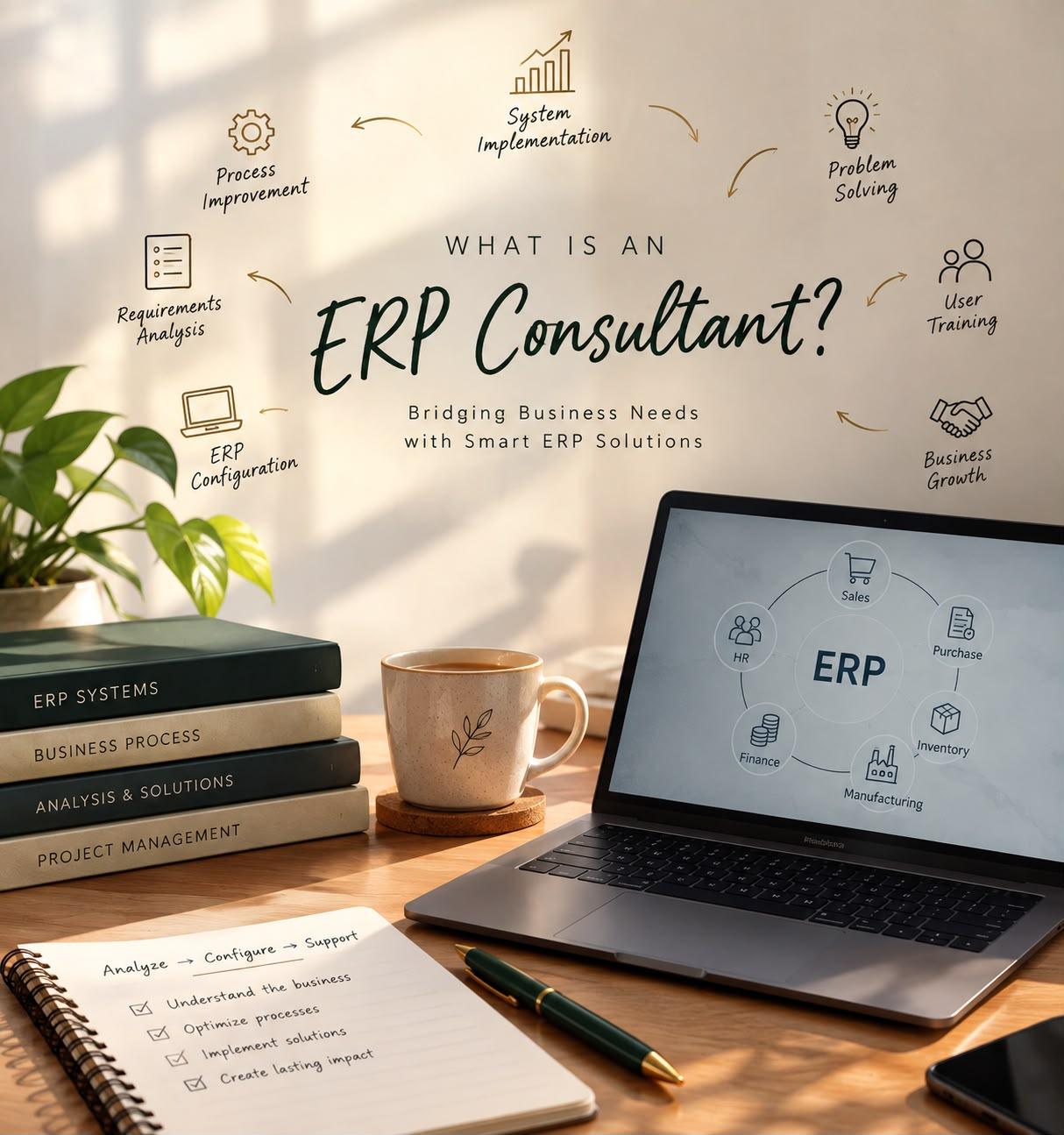
Businesses today manage a large amount of information across sales, purchasing, accounting, inventory, manufacturing, human resources, and other departments. Managing these activities separately can lead to duplicate data, manual work, communication gaps, and difficulty accessing accurate information.
This is where an ERP (Enterprise Resource Planning) system can help.
But implementing an ERP system is not simply a matter of installing software. Businesses need to understand their processes, configure the system correctly, migrate existing data, train employees, and continuously improve the system.
This is where an ERP consultant plays an important role.
An ERP consultant is a professional who helps businesses implement, configure, manage, and improve ERP systems according to their specific business requirements.
In simple terms, an ERP consultant acts as a bridge between the business and the ERP system, helping people, processes, and technology work together efficiently.
What Does an ERP Consultant Do?
An ERP consultant works closely with a business to understand how it operates and then helps configure the ERP system to support those processes.
Depending on the project, an ERP consultant may be responsible for:
- Understanding business requirements
- Studying existing business processes
- Identifying process gaps and improvement opportunities
- Configuring ERP modules and settings
- Setting up workflows and approval processes
- Managing users and permissions
- Setting up sales, purchasing, accounting, inventory, and other processes
- Importing and organizing business data
- Testing business processes
- Identifying problems and providing solutions
- Training employees
- Supporting users after implementation
- Improving the ERP system as business requirements change
The exact responsibilities can vary depending on the size of the business, the ERP platform, and the consultant's area of expertise.
How Does an ERP Consultant Work?
ERP consulting usually follows a structured process. While the exact approach can differ from one project to another, the following stages are common:
1. Understanding the Business
The consultant first needs to understand how the company operates. This may include studying:
- Departments
- Products and services
- Customers and suppliers
- Employees and user roles
- Warehouses and locations
- Sales processes
- Purchasing processes
- Accounting processes
- Manufacturing operations
- Existing software and systems
Understanding the business before configuring the ERP system is important because the ERP should support actual business requirements.
2. Requirement Analysis
After understanding the business, the consultant identifies what the company needs from the ERP system. This may involve reviewing existing processes and identifying:
- Manual activities
- Duplicate data entry
- Approval requirements
- Reporting requirements
- Integration requirements
- Process bottlenecks
- Areas that need automation
The goal is to determine how the ERP system can support the company's operations more effectively.
3. ERP Configuration
Once the requirements are understood, the consultant configures the ERP system. Depending on the business, this may include setting up:
- Companies
- Warehouses
- Items
- Customers
- Suppliers
- Accounts
- Cost centers
- Taxes
- Price lists
- Workflows
- User roles & permissions
Configuration allows the ERP system to reflect the way the business operates.
4. Data Migration
Businesses usually already have data stored in spreadsheets, legacy software, databases, or other systems. An ERP consultant may help migrate this information into the new ERP system.
Data migration can include:
- Item master data
- Customer records
- Supplier records
- Opening balances
- Stock information
- Account information
- Historical or required transaction data
Data needs to be cleaned, mapped, validated, and imported carefully to avoid problems after implementation.
5. Testing
Before going live, the consultant tests different business processes to make sure the system works correctly.
For example, a standard purchasing process may follow:
A typical sales process may involve:
Testing helps identify configuration problems, workflow issues, permission problems, and other gaps before users start working with the live system.
6. User Training
An ERP system is only useful when employees know how to use it correctly. ERP consultants train users based on their roles and responsibilities:
- Sales users: Learn sales cycles and customer management
- Purchase users: Learn procurement and vendor workflows
- Warehouse users: Learn inventory movements and stock reconciliations
- Accountants: Learn ledgers, reconciliation, and financial closing
- Managers: Learn analytics dashboards and real-time reports
Good training helps employees understand not only how to use the system, but also why the new process is being followed.
7. Support and Continuous Improvement
ERP implementation does not end when the system goes live. Users may discover new requirements, encounter issues, or request improvements.
An ERP consultant provides ongoing support to help businesses:
- Resolve system issues
- Improve workflows
- Add new custom reports
- Configure new business processes
- Support new branches or warehouses
- Integrate additional third-party systems
- Improve automation
Why Is an ERP Consultant Important?
Every business has its own processes and requirements. A standard ERP system may not perfectly match the way every company operates. An ERP consultant helps connect the company's requirements with the capabilities of the ERP system.
For example, a company may have a specific approval process for purchases. Instead of handling approvals manually through emails or messages, an ERP consultant can configure an appropriate workflow where a Purchase Order moves through the required approval stages automatically.
This helps businesses:
- Reduce manual work
- Improve data accuracy
- Standardize business processes
- Reduce duplicate data entry
- Improve communication between departments
- Make business information easier to access
- Improve reporting
- Support better decision-making
Types of ERP Consultants
ERP consultants can specialize in different areas depending on their experience and expertise:
Functional ERP Consultant
A functional ERP consultant focuses primarily on business processes and requirements across accounting, sales, purchasing, inventory, manufacturing, and HR. They translate real-world business needs into system configurations.
Technical ERP Consultant
A technical ERP consultant focuses on the technical architecture—customization, custom scripts, APIs, integrations with third-party software, databases, performance optimization, and technical troubleshooting.
ERP Implementation Consultant
An ERP implementation consultant oversees the entire lifecycle of an ERP project from project planning, requirement analysis, configuration, data migration, and testing, through to user training, go-live, and post-implementation support.
What Skills Does an ERP Consultant Need?
An ERP consultant generally needs a balanced mix of business acumen and technical skills:
- Understanding business processes and workflows
- Deep knowledge of the ERP platform
- Analytical problem-solving capabilities
- Clear communication and active listening
- Basic accounting and financial knowledge
- Data analysis and data mapping skills
- System configuration, testing, and debugging
- Project management and change management
- User training and documentation skills
ERP Consultant vs ERP User
| Aspect | ERP User | ERP Consultant |
|---|---|---|
| Primary Role | Uses the system to perform daily business operations | Designs, configures, implements, and optimizes the system |
| Typical Tasks | Creating invoices, recording payments, managing inventory, generating day-to-day reports | Workflow setup, permission management, data migration, troubleshooting, user training |
| Focus | Executing specific departmental tasks | Aligning organization-wide processes with software capabilities |
Common Challenges Faced by ERP Consultants
- Understanding Complex Requirements: Balancing distinct departmental needs into a cohesive system workflow.
- Data Migration: Cleaning and transforming legacy data that contains duplicates, missing fields, or inconsistent formats.
- User Adoption & Change Management: Helping employees transition smoothly from familiar manual spreadsheets or old systems.
- Customization vs Configuration: Deciding whether a business requirement should be solved using out-of-the-box settings, workflows, or custom code.
- System Integrations: Securely connecting the ERP with payment gateways, e-commerce stores, and third-party logistics software.
The Role of an ERP Consultant in Business Growth
As a company grows, it frequently adds new products, warehouses, branches, employees, and suppliers. An ERP consultant ensures the system scales effortlessly by setting up new cost centers, automated approval rules, inter-company transactions, and consolidated financial reporting.
ERP Consulting Is More Than Software Implementation
A common misconception is that ERP consulting is simply about installing and configuring software. In reality, ERP consulting is about understanding the relationship between people, processes, data, and technology.
A successful ERP project requires understanding how employees work, how departments interact, how information moves across the organization, and where bottlenecks can be eliminated.
Conclusion
An ERP consultant plays an essential role in helping organizations unlock the true potential of their ERP investments. From requirements gathering and system setup to data migration, testing, training, and ongoing optimization, they ensure that the software matches the business rather than forcing the business to change around rigid software.
An experienced ERP consultant acts as a bridge between the business and the ERP system—helping people, processes, data, and technology work together seamlessly.
Looking for Expert ERPNext / Odoo Consulting?
At Nexeves Technologies, our certified consultants help businesses streamline operations, eliminate manual bottlenecks, and achieve scalable growth.
📞 Phone: +91 8089051848 | ✉️ Email: info@nexeves.com


No comments yet. Login to start a new discussion Start a new discussion