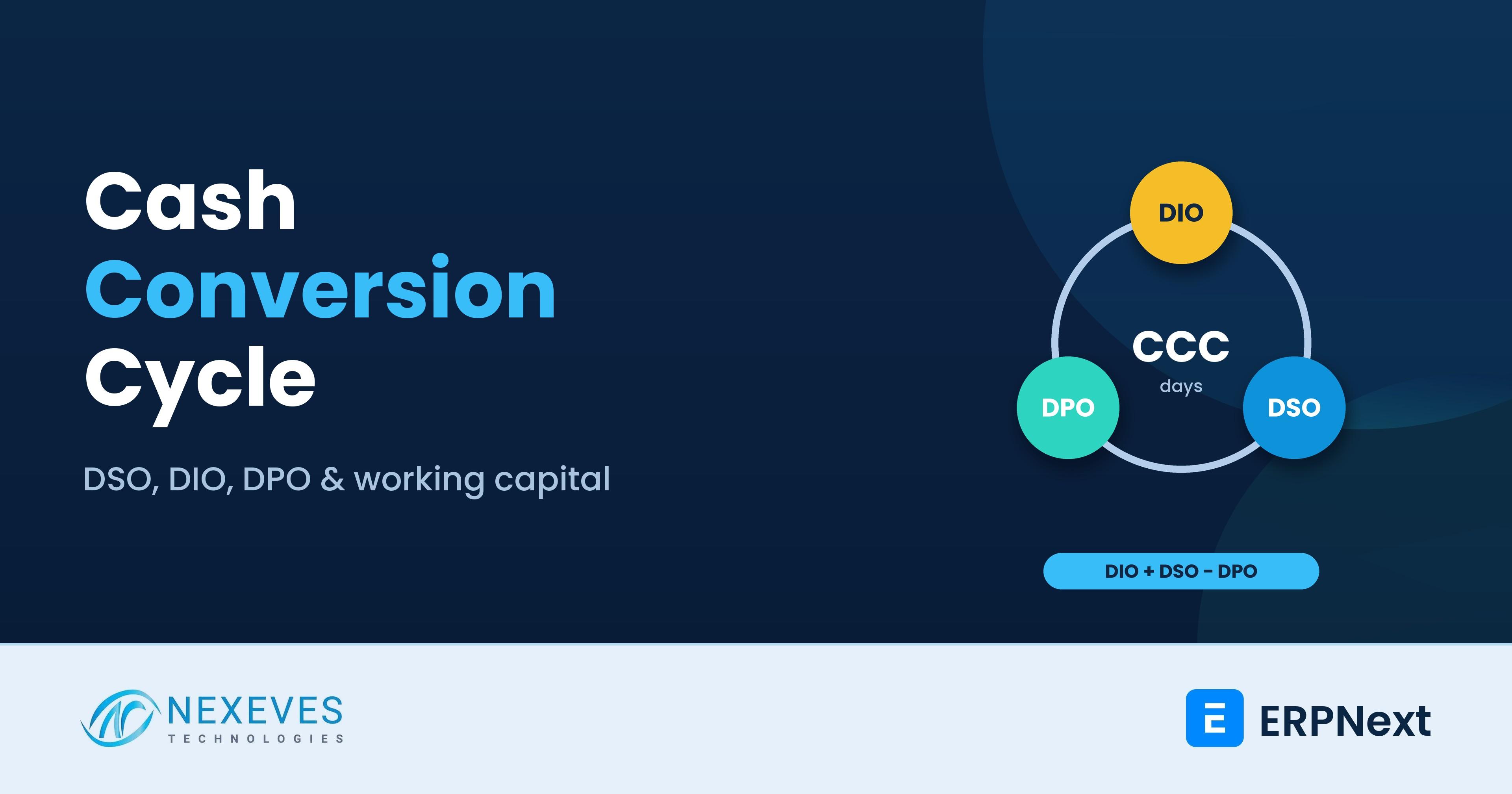
Many owners have lived this: sales are growing, the business shows a profit, and yet there is never enough cash. Suppliers want payment, salaries are due, and customers say "the cheque will come next week". Profit is an accounting result. Cash is what pays bills. The gap between them is working capital, and the clearest way to see it is the cash conversion cycle.
The cash conversion cycle (CCC) measures how many days your cash is tied up between paying for stock and collecting from the customer who bought it. A shorter cycle means you need less borrowing to run the same business. A longer one means growth consumes cash, which is why fast-growing companies sometimes fail while profitable.
This guide shows how to calculate CCC from your ERP data, with a worked example in hypothetical numbers, the levers to shorten it, the ERPNext reports to use, and the cautions around supplier payment rules in India and the GCC. We use no industry averages, because yours is the only number that matters. For a wider view, see our guide to cash flow visibility with ERPNext.
Key takeaways
- CCC = DIO + DSO - DPO. Days inventory outstanding plus days sales outstanding, minus days payables outstanding.
- Each day has a cash value. One day of DSO is your annual credit sales divided by 365. That makes improvements easy to price.
- Do not stretch suppliers blindly. In India, delayed payments to micro and small enterprises have tax consequences, and in the GCC cheque habits and relationships matter. Confirm with your accountant.
- ERPNext holds the data: Accounts Receivable, Accounts Payable, Stock Balance and Ageing, and the P&L give you the inputs every month.
Profitable on paper, but short of cash?
Send us last year's receivables, stock and payables. We will calculate your cycle in a free 30-minute session and show where the cash is stuck.
Calculate my cycle → WhatsApp us: +91 8089051848
Or email info@nexeves.com
The three building blocks
| Measure | Formula | What it tells you |
|---|---|---|
| DSO (days sales outstanding) | Average accounts receivable / credit sales x days in period | How long customers take to pay |
| DIO (days inventory outstanding) | Average inventory / cost of goods sold x days in period | How long stock sits before it is sold |
| DPO (days payables outstanding) | Average accounts payable / cost of goods sold x days in period | How long you take to pay suppliers |
| CCC (cash conversion cycle) | DIO + DSO - DPO | Days of cash tied up in operations |
Use consistent periods. A 365-day year with annual figures is the simplest. For seasonal businesses, compute monthly or quarterly using the matching days and average balances. Some analysts use purchases instead of cost of goods sold for DPO. Pick one rule and keep it, since trends matter more than the absolute number. Service companies have little or no inventory, so their cycle is mostly DSO less DPO.
A worked example (hypothetical)
These are invented figures to show the method. Replace them with your own.
| Input (hypothetical, in lakh) | Value |
|---|---|
| Annual credit sales | 1,200 |
| Annual cost of goods sold | 900 |
| Average receivables | 200 |
| Average inventory | 150 |
| Average payables | 100 |
| Measure | Calculation | Result |
|---|---|---|
| DSO | 200 / 1,200 x 365 | 61 days |
| DIO | 150 / 900 x 365 | 61 days |
| DPO | 100 / 900 x 365 | 41 days |
| Cash conversion cycle | DIO + DSO - DPO | 81 days |
In this example, each purchase turns into collected cash roughly 81 days after the cash goes out. Here is what a few improvements would release:
| Lever | Change | Cash released (lakh) |
|---|---|---|
| Collect faster | DSO down by 10 days | about 33 |
| Hold less stock | DIO down by 10 days | about 25 |
| Pay later, if terms allow | DPO up by 5 days | about 12 |
Collecting ten days faster releases more cash than paying suppliers five days later, and it does not strain supplier relationships. The point is not the numbers, which are made up, but the method: every day in the cycle has a price, so you can rank actions by cash released and effort.
Want the working capital calculator?
Message us and we will send the DSO, DIO and DPO spreadsheet from this post, with the ERPNext report mapping.
Send me the calculator → WhatsApp us: +91 8089051848
Or email info@nexeves.com
Get the inputs from ERPNext
| Input | ERPNext source | Tip |
|---|---|---|
| Credit sales | Sales Register, or Profit and Loss income by period, excluding cash and POS sales | Separate cash sales or the DSO will look too good |
| Cost of goods sold | Profit and Loss Statement, or Gross Profit report | Needs correct valuation rates and complete purchase receipts |
| Average receivables | Accounts Receivable and Accounts Receivable Summary at period start and end (or monthly) | Check unallocated payments and advances, which understate receivables |
| Average inventory | Stock Balance and the Balance Sheet stock account at period start and end | Reconcile stock value to the ledger first |
| Average payables | Accounts Payable and Accounts Payable Summary | Include supplier advances and unposted bills |
| Ageing detail | Accounts Receivable ageing bands, Stock Ageing report | Find which customers and items hold the cash |
Garbage in, garbage out: if invoices are entered late or stock is not reconciled, the CCC will mislead. Our posts on daily accounting in ERPNext and financial reports help you get the books clean. Then build a monthly dashboard with the three days numbers, using our dashboard guide.
Lever 1: Shorten DSO (collect faster)
- Set credit terms by customer with Payment Terms templates, and apply credit limits on the Customer. Review limits when the customer's payment behaviour changes.
- Invoice on time and correctly. A wrong GSTIN, a missing PO number or a late invoice gives customers an excuse to wait.
- Chase systematically. Use the receivables ageing report weekly, assign each overdue customer to an owner, and send reminders. Our guide to automated overdue invoice alerts shows the setup, and ERPNext also has a Dunning feature for reminder letters.
- Offer an early-payment discount through payment terms when the numbers justify it. Compare the discount with your cost of borrowing.
- Make paying easy: payment links and bank details on every invoice. See Razorpay payment links and reconciliation in ERPNext.
- Take advances or stage payments for custom or large orders.
- Handle cheques actively in cheque-heavy markets: track post-dated cheques by maturity date, deposit on time, and chase bounced cheques immediately.
Lever 2: Shorten DIO (hold less, hold smarter)
- Rank items by value and movement, and set rules by class. See our guide to stock ageing and balance.
- Stop reordering dead items, and clear slow stock with a deliberate plan.
- Use reorder levels based on real demand and lead time, not on fear.
- Negotiate smaller, more frequent deliveries for A items, if the supplier cost allows.
- For manufacturers, shorten production lead times and reduce work in progress. See how to reduce production delays.
Lever 3: Manage DPO (pay on agreed terms, not early or randomly)
Paying suppliers later improves the cycle but has limits. Use it as discipline, not as a squeeze:
- Pay on the due date, not before and not after. Many businesses pay early out of habit, which wastes cash, or late, which hurts trust and sometimes prices.
- Negotiate terms as part of a larger commercial relationship, not as a surprise.
- Use supplier early-payment discounts when the saving beats your cost of funds.
- India: be careful with micro and small enterprise suppliers. Under the MSMED Act, payment terms are limited, with a written agreement allowed up to 45 days and 15 days without one. Under section 43B(h) of the old Income-tax Act, now section 37(2)(g) of the Income-tax Act, 2025 from 1 April 2026, delayed payments to micro and small enterprises can make the expense deductible only when it is paid. Ask your CA how this applies to your suppliers, and tag them in your supplier master so reports can flag them.
- GCC: terms and cheque practices vary by country and sector. Follow the contract and local rules, and ask your adviser where unsure.
Our guide to procurement automation and the explanation of purchase orders show how to record payment terms so that the due-date report is reliable.
Reading the cycle correctly
- Trend beats snapshot. Track monthly, and investigate any worsening of more than a few days.
- Segment it. Compute DSO by customer group, DIO by item group and DPO by supplier group. The average hides the problem accounts.
- Link it to profit. A customer who pays in 120 days may be unprofitable once financing cost is counted. See our guide on building a business case for how to value cash.
- Watch the side effects. Aggressive collections can lose customers. Aggressive stock cuts can cause stock-outs. Agree the guard-rails with sales and operations.
A simple monthly working capital routine
- Day 5: finance computes DSO, DIO, DPO and CCC and updates the dashboard.
- Day 7: a 30-minute review with sales, purchase and operations. Top 10 overdue customers, top 10 slow items, upcoming large supplier payments.
- Assign owners and dates for each action, and track them in ERPNext using tasks or assignments.
- Next month: compare the numbers, and state the cash released.
How Nexeves helps
We set up payment terms, credit limits, dunning, stock rules and the working capital dashboard in ERPNext, and train your team on the monthly routine. See our ERPNext implementation services or contact us on the contact page.
Frequently asked questions
What is the cash conversion cycle?
It is the number of days between paying for inventory and collecting cash from the customer. It equals days inventory outstanding plus days sales outstanding minus days payables outstanding.
How do I calculate DSO, DIO and DPO?
DSO is average receivables divided by credit sales times the days in the period. DIO is average inventory divided by cost of goods sold times the days. DPO is average payables divided by cost of goods sold times the days. Use the same method every period.
What is a good cash conversion cycle?
It depends on the industry, business model and terms. Compare your own trend over time and against similar businesses you can verify, rather than a single published number.
How can ERPNext help reduce the cash conversion cycle?
ERPNext provides receivables and payables ageing, stock balance and ageing, payment terms, credit limits, dunning and payment links, which together support collections, stock control and payment discipline.
Can I improve cash flow by paying suppliers later?
Only within agreed terms and the law. In India, delayed payments to micro and small enterprises beyond the legal limits can affect the tax deduction for the expense, so check with your accountant before stretching those suppliers.
Does a service business have a cash conversion cycle?
Yes, but with little inventory it is mostly days sales outstanding minus days payables outstanding. Work-in-progress and unbilled time can also tie up cash.
Free cash by fixing process, not by borrowing
Nexeves sets up credit control, payment terms, stock rules and cash dashboards in ERPNext for businesses in India and the GCC.
Book my free cash review → WhatsApp us: +91 8089051848
Or email info@nexeves.com
Nexeves serves India & the GCC: UAE (Dubai, Abu Dhabi), Saudi Arabia (Riyadh, Jeddah), Qatar (Doha), Kuwait, Bahrain and Oman (Muscat).


No comments yet. Login to start a new discussion Start a new discussion