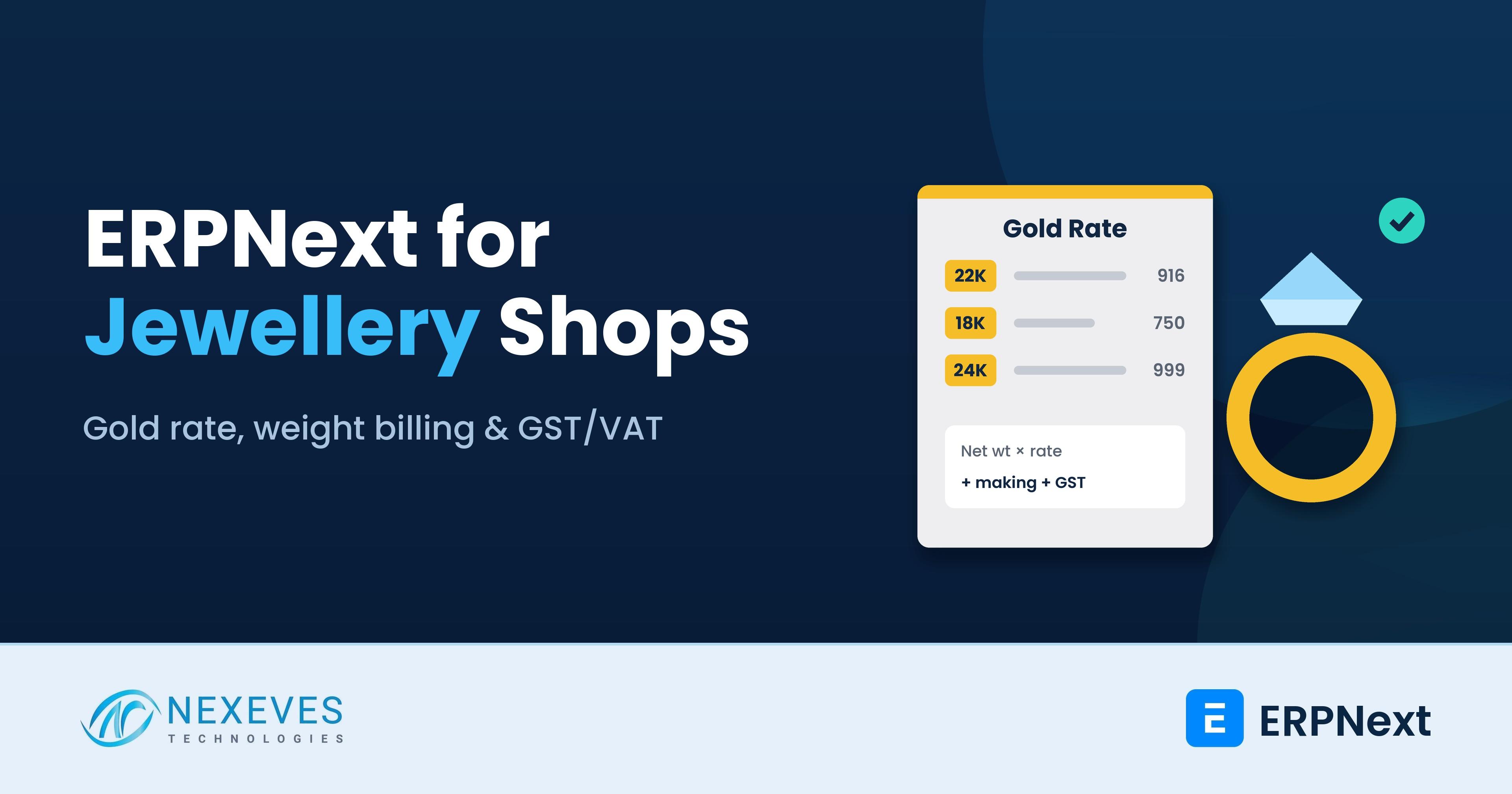
ERPNext for jewellery shops works well once it is set up for the way gold is actually sold: by weight, at a rate that changes every day, with making charges, stone values and old gold coming back across the counter. Out of the box, ERPNext is a general ERP, so a jewellery rollout is mostly about configuration and a few focused customisations rather than a ready-made "jewellery module".
Who this is for: owners and managers of jewellery showrooms, gold and diamond retailers, and jewellery wholesalers in Kerala and across India, and gold souq traders in the UAE, Saudi Arabia, Qatar, Kuwait, Bahrain and Oman, who have outgrown billing-only software or spreadsheets.
Key takeaways
- Price by weight: store gross weight, net weight, stone weight and purity on every piece, and calculate the price from the day's rate.
- One tag, one record: use serial numbers (and the BIS HUID in India) so each piece can be traced from purchase to sale.
- Old gold and karigars: old gold exchange and job work with goldsmiths can be handled with standard ERPNext documents plus small customisations.
- Tax: ERPNext supports Indian GST and UAE/GCC VAT; confirm the exact rates and rules for gold with your tax adviser.
Running a jewellery showroom in Kerala or the GCC?
Book a free 30-minute jewellery ERP walkthrough. We will show weight-based billing, gold rate updates and old gold exchange on a live ERPNext screen, using your own item types.
Show me jewellery billing → WhatsApp us: +91 8089051848
Or email info@nexeves.com
Why jewellery shops need more than billing software
Most jewellery stores start with a billing tool and a stock register. That works until the business has several counters, a second branch, a wholesale line or a steady flow of old gold. Then common problems appear:
- Stock that only balances in pieces, not in grams. The count looks right, but the gold weight does not match the books.
- Manual rate updates. Staff type the day's gold rate into a calculator, and different counters quote different prices.
- Making charges and wastage that vary by salesperson. Discounts are given on the wrong component, and margins leak.
- Old gold exchange on paper. Purity tests, deductions and the value given back are not linked to the new sale.
- Karigar (goldsmith) balances kept in notebooks. Gold issued for making and the finished weight received back are hard to reconcile.
An ERP such as ERPNext puts stock, sales, purchase, job work and accounts in one database, so the gram balance and the money balance come from the same transactions.
How ERPNext models jewellery items
The key design choice is how you represent a piece of jewellery. A practical structure most jewellers can follow:
| What you need | How it is set up in ERPNext |
|---|---|
| Product types (ring, chain, bangle, necklace) | Item Groups, with an Item for each design or category |
| Purity (22K, 18K, 916 etc.) and metal | Item attributes or custom fields on the Item and Serial No |
| Each physical piece with its own tag | Serial No per piece, printed as a barcode or QR tag |
| Gross, net and stone weight | Custom fields on the Serial No and copied to invoice lines |
| Loose gold, bullion and old gold | Items stocked in grams, using a weight unit of measure |
| Stones and diamonds | Separate items, or a stone table on the piece with weight and value |
Because every tagged piece has its own Serial No, the system knows exactly which ring was sold, when it was bought or made, and what it weighed. Barcode tags speed up billing and stock checks.
Hallmarking and HUID in India
Hallmarking of gold jewellery is mandatory in India for most items and districts, and each hallmarked piece carries a 6-digit HUID. In ERPNext the HUID can be stored as a field on the Serial No and printed on the invoice, so it travels with the piece. Check the current BIS rules for your district and the items you sell.
Daily gold rate and weight-based pricing
Jewellery prices are calculated, not fixed. A typical formula is:
Price = (net weight × today's rate for that purity) + making charge + stone value + other charges, then tax.
In ERPNext this is usually built with three pieces:
- A gold rate record. A small custom DocType where the manager enters the day's rate for each purity (and silver or platinum if you sell them). Only authorised roles can change it.
- An invoice script. When a tagged piece is scanned on a Sales Invoice or POS screen, a client script fetches its weights and the current rate, and fills in the price.
- Making charge rules. Making charges can be a rate per gram, a percentage of metal value or a fixed amount per piece, stored on the item or category, with limits on how much staff can reduce them.
This keeps the gold value consistent across counters and branches, and moves negotiation onto the making charge, where you can control it with approval rules.
Showing the calculation on the bill
Customers expect to see the breakdown. A custom print format can show, line by line, the purity, gross and net weight, rate, making charge, stone value, tax and HUID, in English or bilingual Arabic-English for GCC stores.
See your own jewellery tags and invoices in ERPNext
Send us one sample tag, one bill and your current gold rate process. In a free call we will map them to ERPNext fields and tell you exactly what needs customisation.
Map my jewellery process → WhatsApp us: +91 8089051848
Or email info@nexeves.com
Old gold exchange
Old gold is a daily transaction in most showrooms, and it is where weights and values most often go wrong. A clean ERPNext flow looks like this:
- Record the old gold. Weigh it, note the purity test result and any deduction, and value it at the buying rate.
- Receive it into stock. Post it as a purchase from the customer into an "Old Gold" warehouse, in grams.
- Adjust the new sale. Use the old gold value as payment against the new invoice, so the customer pays only the balance.
- Send it on. Move old gold to refining or melting, or issue it to a karigar for new making.
Tax treatment of old gold differs between India and the GCC and can depend on who the seller is, so agree the accounting with your auditor before go-live and build the flow around that decision.
Karigar job work and making
Many jewellers issue gold to goldsmiths and receive finished ornaments back. ERPNext's subcontracting features can model this:
- Issue gold to the karigar against a subcontracting order, so the gold sits in the karigar's warehouse, not your counter.
- Receive finished pieces with their actual weights, and record the agreed wastage allowance and labour charge.
- See the balance of gold with each karigar at any time, in grams and in value.
Our ERPNext manufacturing and job work guide for Kerala SMEs covers the subcontracting flow in more detail; the same logic applies to gold.
GST and VAT for jewellery
| Region | What ERPNext handles | Points to confirm with your adviser |
|---|---|---|
| India | GST invoices, HSN codes, e-invoice and e-way bill through the India Compliance app | Current GST rate on jewellery and on separate job work charges, treatment of old gold, cash limits |
| UAE | VAT invoices, tax templates and the VAT 201 return | Which gold and diamond supplies are standard-rated, zero-rated or under reverse charge |
| Saudi Arabia | VAT invoices; ZATCA Phase 2 e-invoicing through apps | Investment gold rules and e-invoicing integration |
| Qatar, Kuwait, Bahrain, Oman | Multi-company, multi-currency and local tax templates where VAT applies | Whether VAT applies in your country and to which items |
For setup details, see ERPNext GST setup with the India Compliance app or ERPNext UAE VAT and corporate tax setup.
Counters, branches and stock checks
- Warehouses per counter or safe. Each counter, display tray, safe and branch can be its own warehouse, so stock transfers at opening and closing are recorded.
- Weight-based stock reports. Reports can show stock by purity in grams as well as pieces, so a physical check compares both.
- POS for fast billing. The ERPNext POS works for counter sales, with multiple payment modes such as cash, card, UPI and old gold adjustment.
- Customer history. Purchases, orders and scheme payments are saved against the customer, which helps with wedding season follow-ups.
Customer orders and savings schemes
Custom orders can be recorded as Sales Orders with an advance, and the design, weight range and delivery date tracked until the piece is ready. Monthly gold savings schemes need careful design because rules and regulations apply; we usually build them as a separate custom module after reviewing the scheme terms with the client.
A phased ERPNext rollout for a jewellery shop
| Phase | What goes live |
|---|---|
| 1. Foundation | Company, accounts, tax setup, item structure, purities and warehouses |
| 2. Tagging | Serial numbers and weights for existing stock, barcode tags, opening stock by weight |
| 3. Billing | Gold rate record, pricing script, POS and invoice print format |
| 4. Old gold and karigars | Old gold exchange flow, subcontracting with goldsmiths |
| 5. Reports | Daily sales, stock by purity, karigar balances, margin by category |
The biggest effort is usually tagging existing stock correctly. Plan a stock count with weights before go-live, because every later report depends on it.
Common mistakes to avoid
- Tracking jewellery only by piece count. Always keep weights on the piece, or the gram balance will never reconcile.
- Letting anyone change the gold rate. Restrict it to one or two roles and keep a history.
- Mixing old gold with saleable stock. Keep it in its own warehouse until it is refined or reused.
- Over-customising on day one. Start with tagging, pricing and billing; add schemes and advanced reports once the basics are stable.
How Nexeves helps jewellers
- Process study: we review your tags, bills, gold rate routine, old gold handling and karigar records.
- Design: we agree the item and weight structure and the tax treatment with your accountant.
- Build: custom fields, pricing scripts and print formats through our ERPNext customisation service.
- Go-live and training: stock tagging support, counter staff training in English or Malayalam, and support afterwards.
Frequently asked questions
Does ERPNext have a built-in jewellery module?
No. ERPNext is a general ERP. Jewellery features such as weight-based pricing, daily gold rates, making charges and old gold exchange are set up with custom fields, scripts and print formats on top of the standard stock, sales and accounting modules.
Can ERPNext calculate the price from the daily gold rate?
Yes, with a small customisation. The daily rate for each purity is stored in a record, and when a tagged piece is scanned the invoice calculates net weight × rate, adds making charges, stone value and tax, and shows the breakdown on the bill.
Can I track each jewellery piece with its HUID?
Yes. Each piece can be a Serial No in ERPNext with fields for weights, purity and the 6-digit HUID, so the HUID is searchable and can be printed on the invoice.
How is old gold exchange handled in ERPNext?
Old gold is weighed, tested and valued, then received into a separate old gold warehouse. Its value is applied as payment against the new sale, so the customer pays only the balance. Confirm the tax treatment with your auditor.
Can ERPNext manage gold given to karigars?
Yes. Using subcontracting, gold is issued to each karigar and finished ornaments are received back with actual weights, wastage and labour charges, so you can see the gold balance with each goldsmith.
Is ERPNext suitable for jewellery shops in the UAE and GCC?
Yes. ERPNext supports multiple companies, currencies and VAT templates, and invoices can be printed in Arabic and English. Gold and diamond VAT rules are specific, so confirm them with your tax adviser during setup.
Ready to move your jewellery shop to ERPNext?
Nexeves implements and customises ERPNext for jewellery retailers and wholesalers, with training in English or Malayalam and support after go-live.
Book my free jewellery demo → WhatsApp us: +91 8089051848
Or email info@nexeves.com
Nexeves serves India & the GCC: UAE (Dubai, Abu Dhabi), Saudi Arabia (Riyadh, Jeddah), Qatar (Doha), Kuwait, Bahrain and Oman (Muscat).


No comments yet. Login to start a new discussion Start a new discussion