Month-end close rarely slips because the finance manager cannot prepare a profit and loss statement. It slips because the inputs arrive late: a warehouse receipt is missing, a delivery has not been invoiced, customer receipts are unallocated, or the stock value in a spreadsheet differs from the ledger.
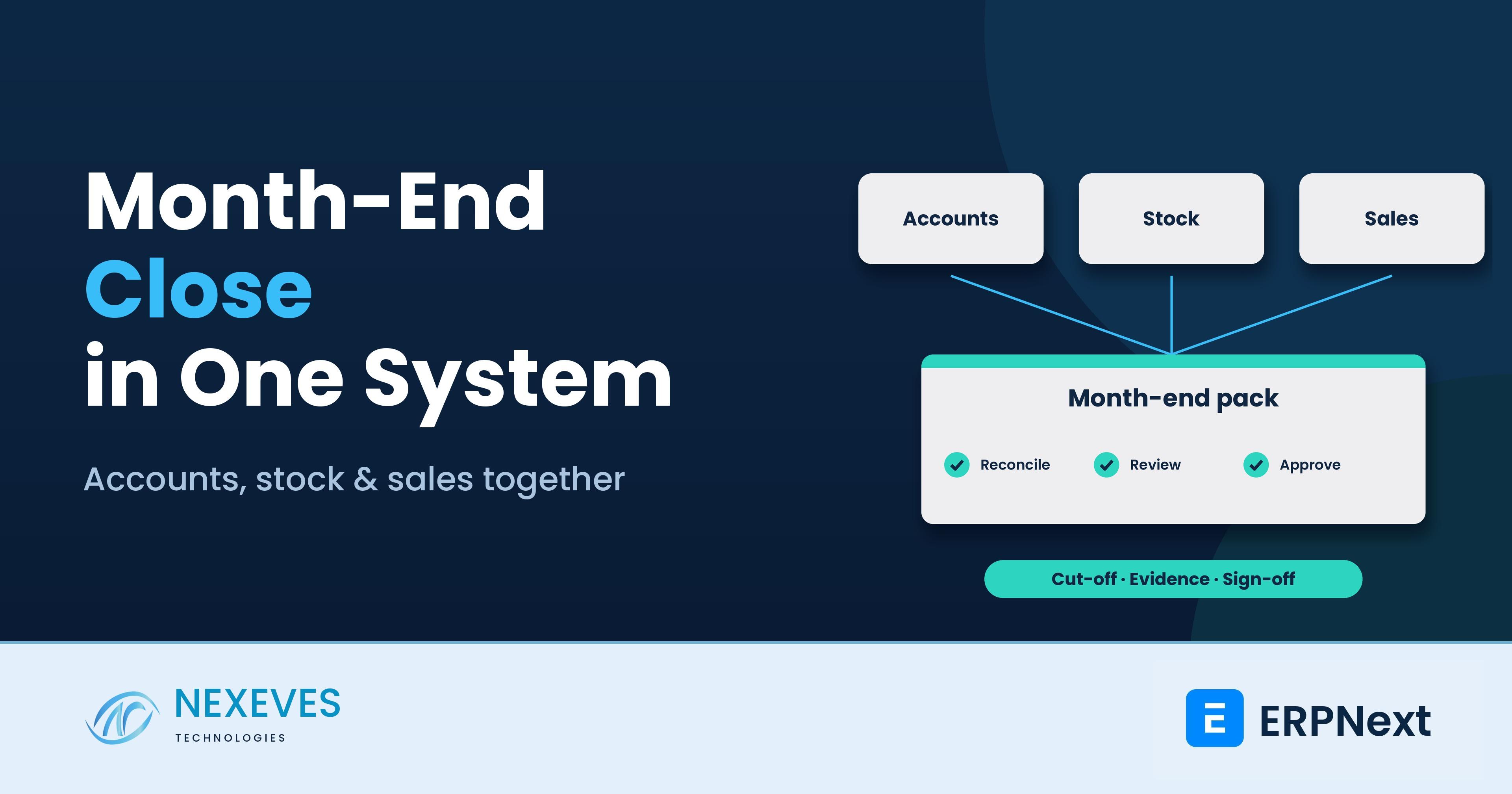
An ERPNext month-end close brings accounts, stock and sales into the same transaction chain. That reduces spreadsheet handoffs, but it does not remove the need for cut-off rules, reconciliations and accountable owners. One database is useful only when people post complete, correctly dated transactions.
This guide sets out a practical close for an India or GCC finance team: what to finish before month-end, which checks to run on days one to three, and what to include in the management pack. Day three is an operating target to adapt to your business—not a promise that software alone will close every company in three days.
- A cut-off that sales, purchasing and warehouses understand.
- Stock quantities and valuation reconciled to the relevant ledger accounts.
- Receivables, payables, banks and tax balances supported by evidence.
- A signed-off pack, an exception register and controls over later changes.
Why close slips when accounts, stock and sales are separate
A Kerala distributor may record invoices in accounting software, dispatches in a warehouse sheet and customer collections in a sales team's messages. Sales says the order is complete; finance sees an unpaid invoice; stores still shows the goods on hand. Each team may be reporting accurately from an incomplete record.
In a UAE trading business, a receipt entered after month-end can change inventory and margin. Missing freight may understate landed cost. A bank receipt recorded without invoice allocation can make overdue balances look larger than they are. These are timing and control problems, not formatting problems.
ERPNext can connect Purchase Receipts, Purchase Invoices, Delivery Notes, Sales Invoices and payments. With perpetual inventory configured, stock movements also affect the General Ledger. But document dates, valuation settings and the distinction between receipt, dispatch, billing and settlement still matter. An invoice marked “Update Stock” must not duplicate a stock movement already recorded through another workflow.
Before month-end: prepare the close instead of chasing it
Publish a close calendar with a named owner and reviewer for every task. State the cut-off date, evidence required and escalation time. Sales owns unbilled dispatches and expected credit notes; stores owns movements and counts; purchasing owns received-not-billed items; finance owns reconciliations and approved adjustments.
- Review open receipts, deliveries, returns and work orders before the last day.
- Count high-value or high-risk stock on a rolling basis; plan any month-end counts and movement controls.
- Request missing supplier invoices, expense claims and intercompany confirmations early.
- Check tax masters, exchange rates and bank statement availability.
- Agree materiality thresholds and treatment of late documents with the finance lead.
Use the same company, currency basis and period in every reconciliation. Keep an exception register showing amount, cause, owner, due date and whether an approved estimate is included in the provisional result. A small unresolved item and a missing container receipt should not have the same escalation priority.
A day-by-day month-end close checklist in ERPNext
| When | Work to complete | Evidence and owner |
|---|---|---|
| Last working day | Communicate cut-off; capture goods in, goods out, returns, production and cash activity | Sales/stores/purchasing certify completeness; count sheets and open-document lists retained |
| Day 1: transaction completeness | Resolve unbilled deliveries and receipts; post approved supplier bills, expenses and production entries; allocate receipts and payments | Document-to-ledger checks and exception list, reviewed by finance with operations |
| Day 2: balance substantiation | Reconcile banks, receivables, payables and stock; review taxes, foreign currency balances, accruals, depreciation and prepayments | Reconciliation schedules with approved journals and supporting calculations |
| Day 3: review and management pack | Review Trial Balance, P&L, Balance Sheet and cash; explain material movements; approve the pack and protect the period | Finance manager sign-off; pack version and unresolved items recorded |
Adjust the timetable for imports, project certification, multiple legal entities or branches. If critical data is missing, label the pack provisional and explain the exposure. Faster reporting is not progress if the numbers must be rebuilt a week later.
Stock valuation: the check that protects reported margin
Start with physical quantities, then investigate valuation. Review Stock Balance and Stock Ledger for unexpected balances, incomplete transfers, missing receipts, incorrect units and late production entries. Complete or investigate pending valuation reposting work before relying on the final report.
In a perpetual-inventory setup, compare the relevant Stock Balance value with the inventory accounts in the Trial Balance or General Ledger at the same cut-off. Include every mapped stock account and warehouse. Investigate manual journals to inventory, backdated transactions, incorrect account mapping and differences in report filters. Do not post a balancing journal merely to hide an unexplained mismatch.
For illustration, suppose the warehouse valuation is ₹48.6 lakh and the relevant ledger accounts total ₹47.9 lakh. The ₹70,000 difference is an investigation item, not automatically a stock loss. Check whether the reports use identical dates, whether an account was omitted and whether adjustments or reposting are incomplete. All figures here are illustrative.
Review received-but-not-billed and delivered-but-not-billed items separately. Physical movement and invoicing can fall in different periods. Confirm the appropriate accrual or revenue cut-off treatment with the accountant rather than treating every open operational document as revenue or expense automatically.
Import businesses should include freight, duty and other eligible landed costs under their accounting policy. Missing costs can overstate gross margin. See our related ERPNext Landed Cost Voucher guide. Manufacturers also need a review of material still in work-in-progress, actual consumption, scrap and completed goods not yet recorded.
Receivables, payables and banks: prove the balances
Accounts Receivable and Accounts Payable
Run ageing as of the month-end date, not today's date. Reconcile the subledger totals to the matching control accounts using a consistent scope. Investigate unallocated advances, credit notes, disputed invoices and unusual debit balances in suppliers or credit balances in customers.
Review long-outstanding amounts with sales or purchasing and document the collection or settlement action. An overdue balance is not automatically a bad debt; an accountant should approve any provision or write-off. Where later payment data affects an as-of report, use the relevant report options consistently and retain the reviewed export.
Bank and cash
Match the bank statement to recorded bank transactions, distinguish uncleared payments from missing entries and book supported bank charges or interest. Payment Reconciliation allocates payments to invoices; bank reconciliation verifies the bank balance. Completing one does not complete the other. Our ERPNext bank reconciliation guide covers that workflow in more detail.
For GCC businesses trading in multiple currencies, check transaction and base-currency balances, approved exchange rates and the required exchange-gain or loss treatment. A customer balance in AED and its base-currency equivalent are two views of one exposure, not interchangeable totals.
GST and VAT belong in the same review—not the same rulebook
For an Indian business, reconcile sales and purchase tax ledgers with source invoices, credit/debit notes and the applicable return data. Review GSTINs, tax classifications, place-of-supply treatment and input-tax-credit eligibility with the tax team. Where relevant, reconcile supplier data against GSTR-2B; a ledger balance alone does not establish credit eligibility.
For a UAE or Saudi business, reconcile the relevant VAT output and input balances to invoices and adjustments and apply the country's rules for recovery, reverse charge and returns. Do not copy an Indian tax template into a GCC company or assume that every GCC jurisdiction has identical VAT requirements.
ERPNext localisation apps, integrations and reports depend on jurisdiction and installed version. Validate the actual tax filing or e-invoicing workflow with the responsible adviser. A management close is not a tax return submission, and a balanced Trial Balance is not evidence that compliance is complete.
The day-three pack a finance manager can act on
- Profit and Loss Statement: current month and year-to-date against the prior period and budget where available, with explanations of material changes.
- Balance Sheet and Trial Balance: material balances supported by reconciliation schedules and a short list of unresolved exceptions.
- Cash position: bank balances, uncleared items and a forward collection/payment view. A historical Cash Flow report does not replace a cash forecast.
- Receivables and payables: ageing, concentrated exposures, disputes, advances and named follow-up owners.
- Stock and margin: valuation reconciliation, slow-moving items, work-in-progress and margin exceptions, with the assumptions behind them.
- Operational cut-off: material unbilled deliveries, receipts awaiting invoices and late adjustments that may change the result.
Use cost centres or accounting dimensions consistently for branch and business-unit analysis. Do not label a branch report a legal-entity statement. Multiple companies need their own reconciliations; group reporting also needs approved intercompany matching and elimination treatment.
Protect the result after sign-off
Control later posting with an Accounting Period or frozen-date settings appropriate to the installed ERPNext version and approved roles. Check the coverage of stock transactions, cancellations and amendments too. A controlled reopening needs an approver, a reason and an updated management pack.
A Period Closing Voucher transfers the period's profit or loss to the selected closing account; it does not itself lock transactions. Do not add one to the monthly checklist automatically. Agree its use with the accountant, particularly for fiscal-year closing. Version-specific requirements, including Stock Closing Entry checks in newer releases, should be validated in the installed system.
How Nexeves sets up a finance-led close
Nexeves Technologies approaches ERPNext implementation by mapping the close backwards from the decisions the finance manager must make. We assess the chart of accounts, warehouse accounts, tax setup, dimensions, document flow and opening data; define a responsibility matrix; then test a full close using representative transactions.
The implementation scope should include reconciliation templates, exception reporting, user training and an agreed escalation path. Establish a baseline—days to approved pack, unresolved reconciling items and late adjustments—then review improvement over subsequent closes. We do not assume a dashboard alone changes the process.
From Vadakara, Kozhikode, Kerala, Nexeves supports ERPNext and Frappe requirements for businesses in India and the GCC. If you currently keep operational stock in ERPNext and accounts elsewhere, reconcile the handoff first; one-system close benefits apply fully only after the relevant transactions and balances are brought together.
Frequently asked questions
Can ERPNext close the month in three days?
It can support a day-three reporting target when master data, transaction discipline and reconciliations are ready. The achievable timetable depends on the business, data quality and approvals. Software alone cannot guarantee it.
Do we need a Period Closing Voucher every month?
Not automatically. It transfers profit or loss to a closing account and is distinct from monthly review and posting restrictions. Agree when to use it with your accountant and validate version-specific requirements.
Does one ERP remove stock reconciliation?
No. You must still verify physical stock, valuation and ledger agreement. Integrated documents reduce handoffs but do not correct missing receipts, incorrect quantities or unsuitable accounting policies on their own.
Can the same close template cover India and the GCC?
The core controls can be shared. Tax rules, currencies, legal entities, localisation and filing workflows must be configured and reviewed for each jurisdiction.
Make your next close a controlled process
Share your current close checklist and the balances that take longest to reconcile. We can assess ERPNext workflows, reporting gaps and responsibilities before proposing changes.
Discuss your ERPNext requirements · WhatsApp +91 8089051848 · info@nexeves.com
Nexeves Technologies | Vadakara, Kozhikode, Kerala | India + GCC


No comments yet. Login to start a new discussion Start a new discussion