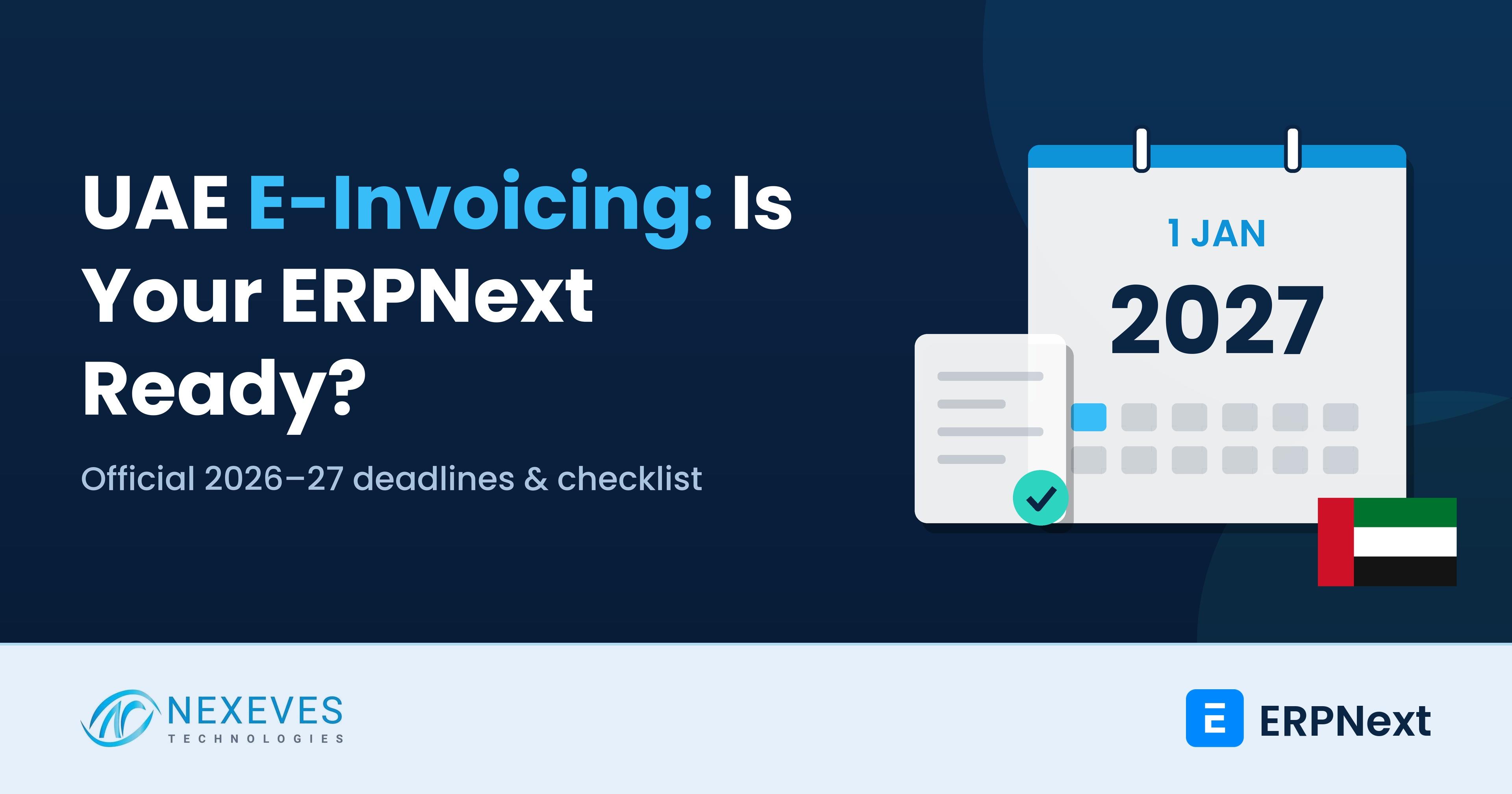
UAE e-invoicing becomes mandatory on 1 January 2027 for businesses with annual revenue of AED 50 million or more, and on 1 July 2027 for everyone else in scope. If you run ERPNext, your system must send structured e-invoices through a Ministry-accredited service provider (ASP).
Larger businesses must appoint that ASP by 30 October 2026. This guide covers the official deadlines and a practical UAE e-invoicing ERPNext readiness checklist.
Who this is for: finance heads and owners of UAE trading, distribution, manufacturing and services companies in Dubai, Abu Dhabi and Sharjah running ERPNext, or planning to. Also useful for GCC groups with UAE entities alongside Saudi Arabia, Qatar, Kuwait, Bahrain or Oman.
Key takeaways
- Revenue ≥ AED 50 million: appoint an ASP by 30 October 2026 (extended from 31 July 2026) and go live by 1 January 2027.
- Revenue below AED 50 million: appoint an ASP by 31 March 2027 and go live by 1 July 2027. Government entities: 31 March 2027 and 1 October 2027.
- Mandatory scope covers B2B and B2G invoices. Under the current official guidelines there's no obligation to issue an e-invoice for supplies to consumers (B2C).
- A PDF or scanned invoice is not an e-invoice. ERPNext must send structured data to your ASP, which exchanges it over the Peppol network and reports to the FTA.
- Missing the ASP or go-live deadline can cost AED 5,000 per month under Cabinet Decision No. 106 of 2025.
Revenue above AED 50 million? Your ASP deadline is 30 October 2026
Get a free UAE e-invoicing readiness check for your ERPNext. In 30 minutes we review your invoice data, customer master and ASP plans, and tell you what must change before go-live.
Get my free UAE e-invoicing readiness check → WhatsApp us: +91 8089051848
Or email info@nexeves.com
UAE e-invoicing deadlines (official timeline)
The timeline comes from Ministerial Decision No. 244 of 2025, as amended by Ministerial Resolution No. 66 of 2026. As of 9 October 2026, the official dates are:
| Who | Appoint an ASP by | Mandatory e-invoicing from |
|---|---|---|
| Pilot group and voluntary adopters | — | 1 July 2026 (already open) |
| Businesses with revenue of AED 50 million or more | 30 October 2026 | 1 January 2027 |
| Businesses with revenue below AED 50 million | 31 March 2027 | 1 July 2027 |
| Government entities | 31 March 2027 | 1 October 2027 |
In May 2026 the Ministry of Finance moved the ASP deadline for larger businesses from 31 July to 30 October 2026. It also stressed that the 1 January 2027 go-live date is unchanged. Always check the official Ministry of Finance e-invoicing page before you plan, because dates can change.
How the AED 50 million threshold works
The official guidelines define revenue as the gross income in your most recent accounting period, based on your financial statements. That's total income, so retail (B2C) sales count towards the AED 50 million figure even though B2C invoices don't need to be e-invoices. If you're close to the line, ask your tax adviser to confirm your phase.
How UAE e-invoicing works
The UAE uses a model the Ministry calls Decentralised Continuous Transaction Control and Exchange (DCTCE), built on the OpenPeppol standard. In plain terms:
- ERPNext creates the invoice as structured data (not a PDF).
- Your ASP validates it and sends it over the Peppol network to your buyer's ASP.
- The buyer's ASP delivers it into the buyer's system.
- Tax data is reported to the Federal Tax Authority (FTA) through the ASP network.
The UAE data specification is commonly called PINT AE. The Ministry publishes a list of mandatory fields and guidance on choosing an ASP. As of May 2026, it had approved 32 service providers, with more in the accreditation pipeline.
What counts as an e-invoice
The Ministry is clear that unstructured formats such as PDF, Word documents, images, scans and emails are not e-invoices. You can still send a PDF copy to customers for convenience, but the legal invoice is the structured one exchanged through ASPs.
Penalties for missing the deadlines
Cabinet Decision No. 106 of 2025 sets the administrative penalties. They apply only to businesses that are mandatorily in scope, not to voluntary adopters:
| Violation | Penalty |
|---|---|
| Not implementing e-invoicing, or not appointing an ASP, on time | AED 5,000 per month |
| E-invoice not issued or sent on time | AED 100 per invoice, capped at AED 5,000 per month |
| E-credit note not issued or sent on time | AED 100 per credit note, capped at AED 5,000 per month |
| Not telling the FTA about a system failure on time | AED 1,000 per day |
| Not telling your ASP about changes to your registered data on time | AED 1,000 per day |
Is ERPNext ready for UAE e-invoicing?
ERPNext already handles UAE VAT well. It has UAE-specific fields (emirate on invoices, zero-rated and exempt flags, reverse charge) and the UAE VAT 201 report. See our ERPNext UAE VAT and corporate tax setup guide for the details.
What ERPNext doesn't do out of the box is talk to the UAE e-invoicing network. You need an integration between ERPNext and your ASP. That usually means one of two things:
- the ASP's connector or API, wired to ERPNext so each submitted Sales Invoice and Credit Note is sent automatically, with the status written back
- a custom Frappe app that maps ERPNext fields to the UAE data specification and calls the ASP's API
Either way, most of the work is in your data, not the connector. Missing TRNs, inconsistent customer addresses and free-text items cause rejections. Our post on how ERPNext keeps audit-ready data explains the controls that help.
Not sure your ERPNext data will pass validation?
Our consultants run a free e-invoicing data audit on a sample of your ERPNext invoices, credit notes and customer records, and give you a fix list before your ASP testing starts.
Book my free e-invoicing data audit → WhatsApp us: +91 8089051848
Or email info@nexeves.com
UAE e-invoicing ERPNext readiness checklist
Work through this list with your finance team and your ERPNext partner.
1. Confirm your phase and dates
- Check revenue from your latest financial statements against AED 50 million.
- Note your ASP deadline (30 October 2026 or 31 March 2027) and go-live date.
- Decide if voluntary early adoption makes sense, so you can test before penalties apply.
2. Choose and appoint an ASP
- Pick from the Ministry's accredited list only.
- Ask each ASP how it connects to ERPNext: a ready connector, a REST API, or file exchange.
- Ask about test environments, error messages, volume pricing and support hours.
3. Clean your master data in ERPNext
- Company: TRN, legal name and address exactly as registered with the FTA.
- Customers and suppliers: TRN for every VAT-registered party, full address with emirate, correct tax category.
- Items: clear names, UOMs and correct tax templates (standard-rated, zero-rated, exempt).
4. Review invoice and credit note flows
- Every credit note should reference the original invoice and give a reason.
- Avoid editing or cancelling submitted invoices. Use credit notes instead.
- Check foreign-currency invoices show VAT in AED.
- Review numbering series per company and branch.
5. Build and test the integration
- Map ERPNext fields to the UAE mandatory field list.
- Send test invoices, credit notes and edge cases (discounts, advances, zero-rated exports) through the ASP's test environment.
- Store the ASP response and status on each ERPNext document, so accounts can see what was accepted or rejected.
6. Train people and set a cut-over date
- Train billing, credit control and accounts on the new statuses and error handling.
- Agree who fixes rejected invoices, and how fast.
- Plan to notify your ASP and the FTA promptly if the system fails, to avoid daily penalties.
Realistic timeline for ERPNext users
If you already run ERPNext with clean data, the work is mostly the ASP integration and testing. If your data needs cleaning or you're still on spreadsheets, start now.
For businesses moving to ERPNext as part of this change, a mid-sized go-live usually takes 2–3 months at Nexeves. Our ERPNext implementation timeline explains each phase, and our ERPNext implementation cost guide covers budgets.
UAE, Saudi Arabia and the rest of the GCC
Saudi Arabia has run mandatory e-invoicing since 2021 under ZATCA, and its Phase 2 integration waves now reach small businesses. If you have entities in both the UAE and KSA (Riyadh or Jeddah), read our ERPNext ZATCA Phase 2 guide.
We also support ERPNext users in Qatar (Doha), Kuwait, Bahrain and Oman (Muscat). We set up each country's rules from that country's official guidance.
How Nexeves helps
Our consultants work with businesses across the UAE and the wider GCC from our base in Kozhikode, India. For UAE e-invoicing we typically:
- Review readiness of your ERPNext data, invoice flows and ASP options.
- Fix master data and invoice processes inside ERPNext.
- Integrate and test with your chosen ASP, then support you through go-live.
Learn more about our ERPNext implementation services and ERPNext accounting.
Frequently asked questions
When does e-invoicing become mandatory in the UAE?
For businesses with annual revenue of AED 50 million or more, e-invoicing is mandatory from 1 January 2027, with an ASP appointed by 30 October 2026. Businesses below AED 50 million must appoint an ASP by 31 March 2027 and go live by 1 July 2027. Government entities follow on 1 October 2027.
Does ERPNext support UAE e-invoicing?
ERPNext supports UAE VAT out of the box, including the UAE VAT 201 report, but it doesn't connect to the UAE e-invoicing network by itself. You need an integration with a Ministry-accredited service provider, either through the provider's connector or API, or a custom Frappe app that maps ERPNext invoices to the UAE data specification.
What is an Accredited Service Provider (ASP) in the UAE?
An ASP is a company accredited by the UAE Ministry of Finance to validate and exchange e-invoices over the Peppol network and report tax data to the FTA. Every business in scope must appoint one. ERPNext sends invoices to the ASP, which delivers them to the buyer's provider.
What are the penalties for not complying with UAE e-invoicing?
Under Cabinet Decision No. 106 of 2025, failing to implement e-invoicing or appoint an ASP on time costs AED 5,000 per month. Late e-invoices or credit notes cost AED 100 each, capped at AED 5,000 a month. Late notice of a system failure costs AED 1,000 per day.
Is B2C included in UAE e-invoicing?
Not for now. The UAE e-invoicing guidelines say there's no obligation to issue an e-invoice for a supply made to a consumer, so the mandate covers B2B and B2G transactions. Retail sales still count towards your revenue when you work out whether you fall in the AED 50 million phase.
Is a PDF invoice valid under UAE e-invoicing?
No. The Ministry of Finance says unstructured formats such as PDF, Word files, images, scans and emails are not e-invoices.
The legal e-invoice is the structured data exchanged through accredited service providers. You can still send customers a PDF copy for convenience.
Get ERPNext e-invoicing-ready before your deadline
Book a free UAE e-invoicing readiness check with Nexeves. We help businesses in Dubai, Abu Dhabi and Sharjah prepare ERPNext for the UAE e-invoicing system, and we also serve Qatar, Kuwait, Bahrain and Oman.
Book my free readiness check → WhatsApp us: +91 8089051848
Or email info@nexeves.com
Nexeves serves India & the GCC: Kerala and the rest of India, plus the UAE (Dubai, Abu Dhabi), Saudi Arabia (Riyadh, Jeddah), Qatar (Doha), Kuwait, Bahrain and Oman (Muscat).


No comments yet. Login to start a new discussion Start a new discussion