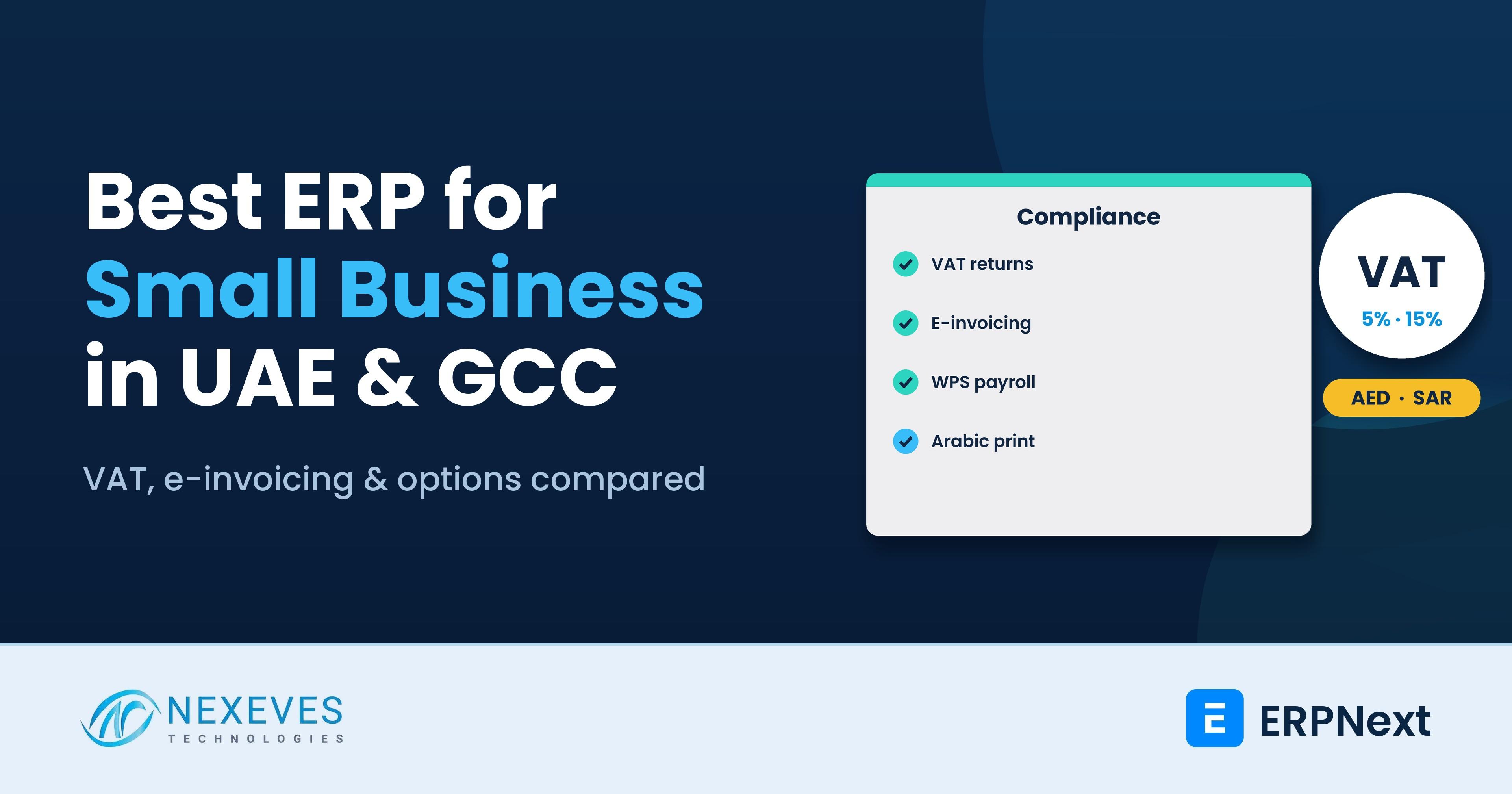
A small business in Dubai, Riyadh or Muscat faces a different set of rules from one in India, and the rules are moving fast. VAT is in force in most Gulf states, the UAE has set dates for mandatory e-invoicing, Saudi Arabia has run e-invoicing for years, and payroll must follow wage protection systems. A system that was fine three years ago may not be fine for the next three.
This guide helps you choose ERP software for a small or mid-sized business in the UAE and wider GCC. We implement ERPNext, so we have a stake, and we say so. We describe six common options by fit, give you a compliance checklist and a selection process, and avoid quoting prices, which vary by users, modules and partner. For the Indian version of this decision, read Best ERP for Small Business in India.
Key takeaways
- Compliance drives the choice in the GCC: VAT, e-invoicing, wage protection and Arabic documents all need to work, not just exist on a feature list.
- UAE e-invoicing is phased: according to the Ministry of Finance, businesses with revenue of AED 50 million or more implement from 1 January 2027, and smaller businesses from 1 July 2027.
- Rates differ by country: VAT is 5% in the UAE and Oman, 10% in Bahrain and 15% in Saudi Arabia, while Qatar and Kuwait have no VAT in force.
- Pick a partner as carefully as a product. Local support hours, Arabic capability and real GCC references matter as much as software features.
Choosing an ERP for your UAE or Saudi business?
Book a free 30-minute call. We will go through your trade, VAT position and e-invoicing timeline, and tell you honestly which options deserve a demo.
Get my GCC ERP shortlist → WhatsApp us: +91 8089051848
Or email info@nexeves.com
The GCC compliance checklist
Before comparing products, write down which of these apply to you. They decide the shortlist.
| Country | VAT (2026) | Other rules to plan for |
|---|---|---|
| UAE | 5% | Phased e-invoicing on the Peppol standard through accredited service providers, corporate tax registration and filing, WPS for payroll |
| Saudi Arabia | 15% | ZATCA e-invoicing with Phase 2 integration in waves, GOSI social insurance, Mudad wage protection |
| Oman | 5% | VAT returns and local payroll rules |
| Bahrain | 10% | VAT returns and local payroll rules |
| Qatar | No VAT in force | Local statutory and payroll rules, and banking requirements |
| Kuwait | No VAT in force | Local statutory and payroll rules, and banking requirements |
VAT rates above follow published GCC tax summaries, and the UAE rate is confirmed by the UAE Ministry of Finance. Always confirm current rates with the tax authority or your adviser.
UAE e-invoicing: the dates that matter
The UAE Ministry of Finance announced that e-invoicing applies to business-to-business and business-to-government transactions, based on the Peppol standard, with each issuer and recipient appointing an Accredited Service Provider. A pilot began on 1 July 2026. Businesses with annual revenue of AED 50,000,000 or more implement from 1 January 2027, and businesses below that from 1 July 2027. Appointment deadlines for providers were amended by later ministerial resolutions, so check the Federal Tax Authority for the current dates. Our UAE e-invoicing readiness checklist and Dubai e-invoicing guide go deeper.
Saudi Arabia: ZATCA and payroll
Saudi businesses must issue e-invoices under ZATCA rules, with the integration phase applying in waves by taxpayer. Payroll adds GOSI and Mudad. See our guides on ZATCA Phase 2 in ERPNext and Saudi payroll with GOSI and Mudad.
What a GCC small business should demand from an ERP
- VAT handling by country and by item, including zero-rated, exempt and reverse-charge cases, and correct VAT return reports.
- E-invoicing readiness for your country, with a clear statement of who provides the integration and what it costs.
- Arabic and English documents, including right-to-left print formats for invoices, quotations and payslips.
- Multi-currency and multi-company support if you trade across borders or run branches in several countries.
- WPS and payroll support for your country, or a clear way to produce the bank file.
- Post-dated cheque handling, which is a daily reality for many UAE businesses.
- Local support: response during Gulf working days and hours, and engineers who understand your regulator's expectations.
- Data hosting clarity: where your data lives, who can access it, and how backups work.
Six options for GCC small businesses
These are descriptions of fit. Verify features, localisation and e-invoicing support with each vendor for your specific country and edition.
1. ERPNext
Best for: small and mid-sized trading, contracting, service and manufacturing businesses that want one open-source ERP with UAE VAT and corporate tax support, flexible customisation and a partner-led implementation. ERPNext is licensed under GNU GPL-3.0. Watch out for: e-invoicing for UAE and Saudi Arabia is handled through add-on apps and integrations, so confirm the version and provider. See our UAE VAT and corporate tax guide and ERP for a trading company.
2. Odoo
Best for: businesses that want a modular suite with an attractive interface. Odoo's documentation lists localisations for the UAE and Saudi Arabia, and ZATCA e-invoicing options for Saudi Arabia. Watch out for: check which modules are in your edition and how licence cost grows per user. See ERPNext vs Odoo for India and GCC.
3. Zoho Books
Best for: small businesses that want cloud accounting. Zoho publishes VAT-compliant editions for the UAE, Saudi Arabia, Bahrain and Oman, and states support for ZATCA Phase 2 in Saudi Arabia. Watch out for: it is accounting-first, so stock-heavy, manufacturing or project-driven operations may need additional Zoho apps or tools. See ERPNext vs Zoho One.
4. QuickBooks Online
Best for: very small businesses with simple accounting, already familiar with QuickBooks. Intuit lists availability in the UAE and Saudi Arabia. Watch out for: it is an accounting product, and for e-invoicing in the UAE and Saudi Arabia you should confirm in writing whether native support exists or a third-party connector is needed. If you are leaving it, see our QuickBooks to ERPNext migration guide.
5. SAP Business One
Best for: small and midsize companies that prefer an established SAP product and a partner-led project. Watch out for: licence, implementation and add-on costs, and dependence on the partner for localisation. See ERPNext vs SAP Business One.
6. Microsoft Dynamics 365 Business Central
Best for: companies that already use Microsoft 365 and want a cloud ERP through a partner. Watch out for: GCC compliance depends on the partner's localisation, and cost scales with users and add-ons. See ERPNext vs Dynamics 365.
Facing the UAE e-invoicing deadlines?
Tell us your annual revenue band and current accounting software. In a free call we will explain what to prepare and what your ERP must support.
Check my e-invoicing readiness → WhatsApp us: +91 8089051848
Or email info@nexeves.com
Which fits which type of GCC business?
This table reflects our experience, and you should test it on your own process.
| Business type | Often a good fit | Why |
|---|---|---|
| Trading or distribution company in the UAE | ERPNext, Odoo, Business Central | Stock, landed cost, multi-currency, VAT and cheque handling matter most |
| Contracting or project business | ERPNext, SAP Business One, Business Central | Project costing, subcontractors, retention and progress billing |
| Service company with a small team | Zoho Books, ERPNext | Simple billing first, with room to add projects and HR |
| Retail or restaurant group | ERPNext with POS, or a POS linked to accounts | Fast billing, multi-outlet stock and VAT at the counter |
| Saudi company with significant payroll | ERPNext or Odoo with a Saudi-experienced partner | GOSI, Mudad and ZATCA all need to be handled |
How to choose in two weeks
- Define your compliance profile: which countries, your revenue band for UAE e-invoicing, and your payroll rules.
- List ten daily tasks and five monthly reports, including the VAT return and the owner's cash report.
- Shortlist two or three options from the list above.
- Run the same demo script with each, using your own invoices, an Arabic invoice and a post-dated cheque.
- Ask each partner for GCC references of similar size, and speak to them.
- Compare five-year cost: licence or subscription, implementation, customisation, hosting, support, e-invoicing provider fees and upgrades.
- Check the exit: how you export your data if you change vendor.
Our guide to evaluating ERPNext with a demo or free trial has a script you can reuse, and our post on choosing between a partner, a freelancer and an in-house team helps with the second half of the decision.
Common mistakes GCC businesses make
- Treating VAT as the only compliance item. E-invoicing and payroll rules affect system choice just as much.
- Buying on a feature checklist. A feature that exists in a brochure may not be configured for your country or edition.
- Leaving Arabic until after go-live. Print formats and customer-facing documents take time to get right.
- Underestimating cut-over. Opening balances, outstanding invoices and cheques need careful migration. See our post on ERPNext data migration challenges.
- Waiting for the e-invoicing deadline. Teams that start close to a deadline pay more and test less.
How Nexeves helps GCC businesses
We serve businesses across the UAE (Dubai, Abu Dhabi), Saudi Arabia, Qatar, Kuwait, Bahrain and Oman. We start with a discovery call, give you an honest shortlist even when it is not ERPNext, and, if ERPNext fits, deliver implementation with local compliance, Arabic documents, training and support. See our ERPNext implementation services.
Frequently asked questions
What is the best ERP for a small business in the UAE?
There is no single best. ERPNext, Odoo, SAP Business One and Business Central suit businesses that need stock, sales, purchase and projects together, while Zoho Books and QuickBooks Online suit simple accounting. Choose by compliance fit, partner quality and five-year cost.
When does e-invoicing become mandatory in the UAE?
According to the UAE Ministry of Finance, businesses with annual revenue of AED 50 million or more must implement from 1 January 2027, and businesses below that from 1 July 2027. Confirm current dates with the Federal Tax Authority.
What VAT rate applies in the GCC?
As of October 2026 the standard rate is 5% in the UAE and Oman, 10% in Bahrain and 15% in Saudi Arabia. Qatar and Kuwait have no VAT in force.
Does ERPNext support UAE VAT and Saudi ZATCA?
ERPNext supports UAE VAT and corporate tax setup. Saudi ZATCA and UAE e-invoicing are handled through add-on apps and integrations, so confirm the version and provider for your case.
Do I need Arabic invoices in my ERP?
Many GCC businesses issue bilingual Arabic and English invoices and payslips. Check that the system supports right-to-left print formats and test them before go-live.
How long does it take to choose and implement an ERP in the GCC?
A focused selection takes about two weeks. Implementation depends on scope: a simple setup can take weeks, while multi-branch or manufacturing projects take months.
An ERP that follows GCC rules from day one
Nexeves implements ERPNext for companies in the UAE, Saudi Arabia, Qatar, Kuwait, Bahrain and Oman, with local compliance, training and support.
Book my free GCC ERP consultation → WhatsApp us: +91 8089051848
Or email info@nexeves.com
Nexeves serves India & the GCC: UAE (Dubai, Abu Dhabi), Saudi Arabia (Riyadh, Jeddah), Qatar (Doha), Kuwait, Bahrain and Oman (Muscat).


No comments yet. Login to start a new discussion Start a new discussion